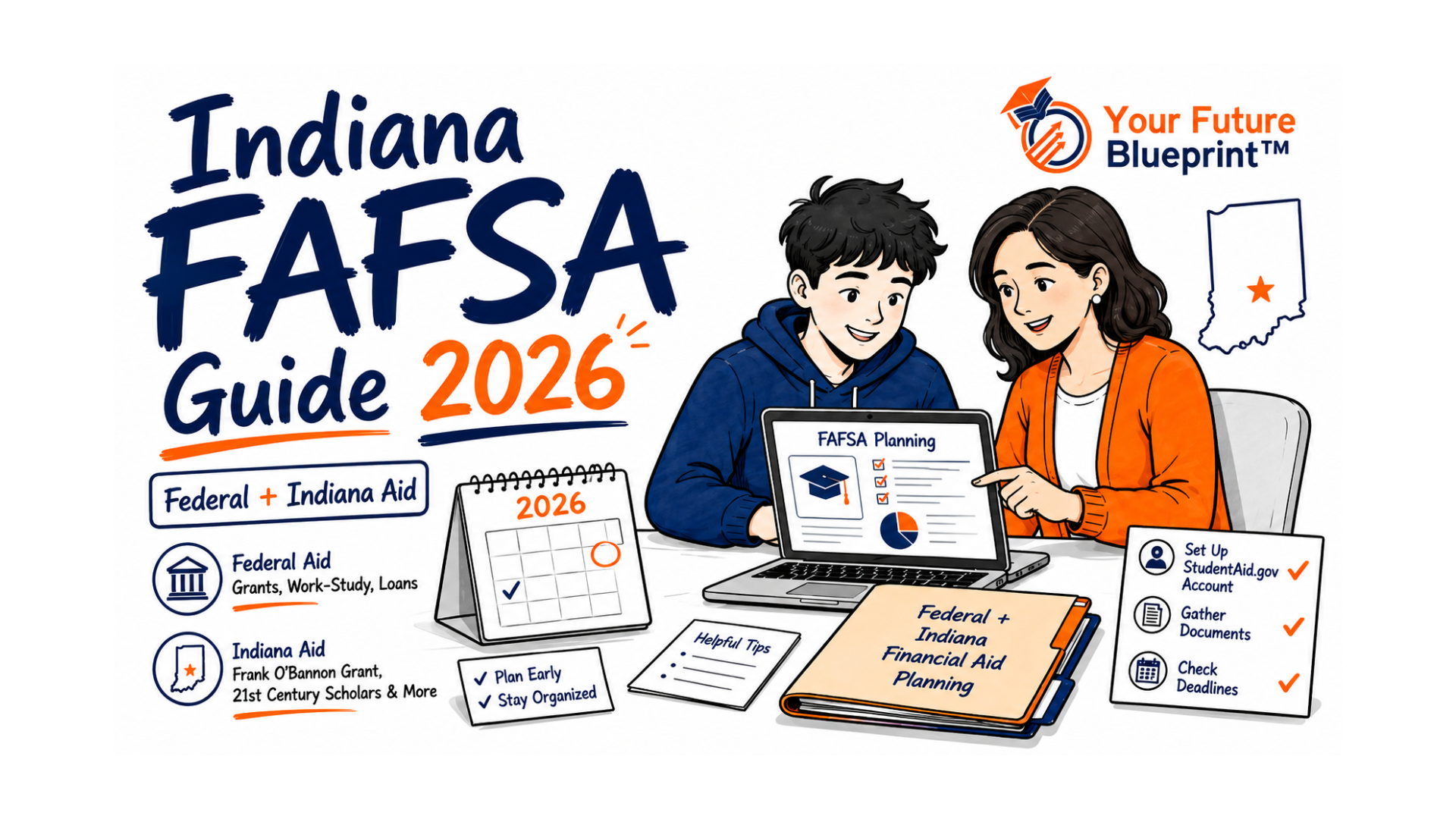
Indiana FAFSA Guide 2026
If you are an Indiana student attending college or career school during the 2026–27 academic year, the FAFSA you need is the 2026–27 Free Application for Federal Student Aid.
That award year covers attendance from July 1, 2026, through June 30, 2027. The FAFSA is currently open, and the federal submission deadline is June 30, 2027. But Indiana students need to pay attention to a much earlier date: April 15 is an important Indiana FAFSA deadline for state financial aid programs such as the Frank O'Bannon Grant.
If you missed April 15, do not assume there is no reason to complete the FAFSA. The federal FAFSA remains open, college deadlines can differ, and Indiana has a financial-aid appeal process that may apply in certain documented circumstances. Submit the FAFSA if you still need to file, then check directly with your college financial aid office and the Indiana Commission for Higher Education about what options remain available.
What the FAFSA Actually Does
The FAFSA is an application for student aid. It is not financial aid itself and it does not guarantee that a student will receive a grant, scholarship, loan, work-study position, or complete college funding package.
Federal Student Aid uses FAFSA information to help determine eligibility for federal programs. Colleges and states may also use FAFSA information when determining eligibility for their own aid programs. Federal aid can include grants, Federal Work-Study, and federal student loans.
Those types of assistance are not financially equivalent.
Grants generally do not need to be repaid, although exceptions can apply. Federal Work-Study allows eligible students to earn money through qualifying employment, but receiving a work-study award does not necessarily guarantee that a student will obtain a job. Federal student loans are borrowed money and must be repaid according to the applicable loan terms. Scholarships have their own eligibility requirements and may come from colleges, state programs, community organizations, employers, foundations, and other providers.
Completing the FAFSA also does not automatically apply a student to every scholarship.
Know Which FAFSA Deadline You Are Looking At
One of the easiest financial-aid mistakes is treating every FAFSA-related deadline as if it were the same deadline.
For 2026–27, there are four different types of dates Indiana families should watch:
- Federal FAFSA deadline: June 30, 2027, at 11:59 p.m. Central Time.
- Indiana state-aid deadline: April 15 is important for programs including the Frank O'Bannon Grant and 21st Century Scholarship requirements.
- College priority deadline: Set individually by each college and potentially much earlier than the federal deadline.
- Scholarship deadline: Set by the scholarship provider and may require a separate application.
Indiana also requires high school seniors to either file the FAFSA or affirmatively opt out by April 15. That graduation-related requirement should not be confused with a guarantee of state financial aid. State-aid programs have their own eligibility requirements.
The safest approach is to follow the earliest deadline that applies to you, not to use the federal June 30 deadline as your planning target.
What You Need for the 2026–27 FAFSA
Start by making sure the student has a StudentAid.gov account. Every person identified as a required contributor must use their own account rather than sharing the student's or another family member's login.
For the 2026–27 FAFSA, students may also need:
- Email addresses for required contributors
- 2024 federal income and tax information
- Current information about cash, checking, savings, investments, and other assets when required
- Child support information when applicable
- A list of colleges, career schools, or trade schools they are considering
The online FAFSA allows students to list up to 20 schools at a time. Schools listed on the FAFSA receive the student's FAFSA information electronically after processing.
The 2026–27 FAFSA specifically uses 2024 tax information. Do not substitute newer tax-year numbers just because your family's income has changed since 2024. There is a different process for handling significant financial changes.
Do Not Use an Old FAFSA Asset Checklist
Some 2026–27 asset rules changed.
Beginning with this award year, the FAFSA excludes from reportable business and farm net worth a family-owned business with 100 or fewer full-time or full-time-equivalent employees, a farm on which the family resides, and certain family-owned and controlled commercial fishing businesses and related expenses.
That does not mean every business, farm, investment, or asset is excluded. Families with complicated business, farm, trust, investment, or ownership situations should follow the questions on the current 2026–27 FAFSA and current Federal Student Aid guidance rather than relying on an older checklist.
Who Is a FAFSA Contributor?
A contributor is someone whose information, consent and approval, and signature may be required on a FAFSA. Depending on the student's circumstances, contributors can include the student, a spouse, a biological or adoptive parent, or a parent's spouse.
A dependent student will generally need parent information, but FAFSA dependency rules are federal student-aid rules—not the same rules the IRS uses to determine whether someone can be claimed as a tax dependent. Simply living away from parents, supporting yourself, or filing your own tax return does not automatically make you independent for FAFSA purposes.
If parents are divorced, separated, remarried, or do not live together, do not guess about which parent should participate. Federal Student Aid provides a “Who's My FAFSA Parent?” tool to help determine whose information is required.
And remember: being identified as a contributor does not mean a parent or spouse has agreed to pay the student's college costs.
What Is the Student Aid Index?
After the FAFSA is processed, the student will receive a Student Aid Index, or SAI.
The SAI is an eligibility index based on FAFSA information. A lower SAI generally indicates greater financial need. But the number is not the student's college bill, not the amount the family is required to contribute, and not a guaranteed financial-aid amount.
Schools use the SAI along with their own cost of attendance when calculating financial need. Because each college has a different cost of attendance and may have different institutional aid resources, the same student can receive very different financial-aid offers from different colleges.
Families with more than one student in college should also know that the number of family members in college is not used in the federal SAI calculation for 2026–27. A college may, however, consider particular family circumstances through its professional-judgment process when appropriate.
How Pell Grants Fit Into the FAFSA
The Federal Pell Grant is generally intended for eligible undergraduate students with significant financial need. Unlike a federal student loan, a Pell Grant normally does not have to be repaid, although certain circumstances can require repayment.
For the 2026–27 award year, the maximum Federal Pell Grant is $7,395. That number is a maximum—not a standard award and not a promise that every eligible student receives $7,395. Eligibility and the actual amount depend on the student's circumstances and applicable federal rules.
Students should not decide they earn “too much” or assume they will qualify based only on household income. Completing the FAFSA using accurate information allows the federal system and colleges to evaluate the student's actual situation.
FAFSA and Indiana State Financial Aid
Indiana uses FAFSA information for important state financial-aid programs, but state requirements remain separate from federal FAFSA requirements.
The Frank O'Bannon Grant is Indiana's primary need-based state financial-aid program. Eligibility includes multiple requirements beyond simply completing a FAFSA, and students must file the FAFSA by April 15 each year to meet the program's FAFSA filing requirement.
For 21st Century Scholars, students must also file the FAFSA by April 15 as high school seniors and each year thereafter while maintaining the program's applicable requirements.
Indiana students should also know about ScholarTrack, the state's portal for state financial-aid information. Some Indiana aid programs require actions or applications beyond submitting the FAFSA, so completing a federal FAFSA should not be treated as proof that every Indiana scholarship or grant application is finished.
What If You Missed Indiana's April 15 Deadline?
For students seeking 2026–27 aid in August 2026, this is particularly important: April 15, 2026 has already passed.
Missing the Indiana deadline may affect eligibility for state programs, but it does not close the federal FAFSA. The federal 2026–27 application remains available through June 30, 2027.
If you have not filed:
- Complete the 2026–27 FAFSA as soon as practical.
- Check your ScholarTrack account and applicable Indiana program requirements.
- Contact your college financial aid office.
- Ask the Indiana Commission for Higher Education whether any state-aid appeal or other process applies to your situation.
Indiana's financial-aid appeals guidance includes certain documented situations related to missing the FAFSA deadline, such as serious illness or the death of an immediate family member. An appeal is not an automatic approval, so students should use the official Indiana process rather than assume an exception will be granted.
What Happens After You Submit the FAFSA?
Submitting the form is an important step, but it is not the end of the financial-aid process.
After processing, the student can access a FAFSA Submission Summary. Review it carefully for the SAI, FAFSA answers, school information, possible eligibility information, and next steps.
The FAFSA Submission Summary is not a college financial-aid offer.
A financial-aid offer comes from a college after the student has been accepted and the school has the information it needs to determine the student's aid. That offer may contain grants, scholarships, work-study, loans, and other forms of assistance.
If the FAFSA contains an error, students can make certain corrections after processing through their StudentAid.gov account. Students should also pay attention to requests from colleges. A student may be selected for verification, which means the school must confirm certain FAFSA information; being selected does not by itself mean the student did something wrong.
What If Your Family's Finances Have Changed Since 2024?
A family may have had a job loss, reduction in income, major medical expenses, or another significant financial change after the 2024 tax year.
The correct response is generally not to replace the required 2024 FAFSA information with what the family earns today.
Complete the FAFSA using the information requested. Then contact the financial aid office at the college the student plans to attend and ask whether the circumstances may qualify for an aid adjustment through professional judgment. The college may request documentation and determines whether an adjustment is appropriate.
Students experiencing unusual circumstances that prevent them from safely contacting parents or obtaining parent information should also follow the current FAFSA instructions and work directly with a college financial aid administrator. Those situations are handled differently from an ordinary disagreement about whether a parent wants to contribute toward college costs.
How to Read Your Financial-Aid Offer
When colleges begin sending aid offers, do not compare them only by the largest total dollar amount.
Separate the offer into:
- Grants and scholarships that generally do not require repayment
- Federal Work-Study that must be earned through employment
- Federal student loans that must be repaid
- Parent borrowing or other financing
- The amount that remains after the aid is applied
Then compare each school's remaining cost and required borrowing, not simply its published tuition or total aid package.
A college offering more total “aid” is not necessarily less expensive if a large portion of that offer consists of loans.
A Practical Indiana FAFSA Checklist
For the 2026–27 award year, an Indiana student can use this sequence:
- Confirm that 2026–27 is the correct FAFSA award year.
- Create or verify the student's StudentAid.gov account.
- Identify required contributors and make sure each has their own account.
- Gather the required 2024 tax information and current asset information.
- Complete and submit the FAFSA using accurate information.
- Review the FAFSA Submission Summary and correct eligible mistakes.
- Check ScholarTrack and Indiana program requirements separately.
- Confirm every college's financial-aid and scholarship deadlines.
- Respond promptly to legitimate requests from financial aid offices.
- Compare college aid offers by grants, scholarships, work-study, borrowing, and remaining cost.
The FAFSA is one part of the college-funding process—not the entire process. The goal is not simply to submit a form. It is to give each applicable college and aid program the information it needs, follow the correct deadlines, review what happens afterward, and make an informed decision about the actual cost of attending.
For Indiana students and families, that means keeping federal FAFSA requirements, Indiana state-aid requirements, college requirements, and scholarship requirements separate.
That is how you turn the FAFSA from a form to complete into information you can actually use.
More FAFSA and Indiana Financial Aid Help
For step-by-step help understanding FAFSA, SAI, contributors, special circumstances, corrections, and financial aid, use the free Financial Aid Track.
FAFSA deadlines can differ at the federal, state, and college level. Review FAFSA Deadlines: Federal, State, and College before deciding when to file.
Indiana students should also review the Indiana Scholarships for High School Students: 2026–27 Guide and, when applicable, the 21st Century Scholars Program.
Parents who want a broader planning roadmap can use the free Parent & Caregiver Track.
Best Next Step
Log in to StudentAid.gov and confirm whether your 2026–27 FAFSA is complete and processed, then check ScholarTrack and your college's financial-aid requirements.
Official Links and Sources
Federal Student Aid — Filling Out the FAFSA Form
Learn the current 2026–27 FAFSA rules, required tax year, and filing guidance.
Federal Student Aid — FAFSA Application Deadlines
Learn the official federal submission and correction deadlines.
Federal Student Aid — FAFSA Checklist: What Students Need
Learn what students and contributors need before completing the FAFSA.
Federal Student Aid — Federal Pell Grants
Learn award-year-specific technical changes.
Indiana Commission for Higher Education — State Financial Aid
Learn Indiana-specific programs and requirements.
Disclaimer: This article provides general educational information about the 2026–27 FAFSA and financial aid in Indiana. Federal, Indiana, college, and scholarship requirements, deadlines, and award amounts can change and may vary by individual situation. Confirm current information with StudentAid.gov, the Indiana Commission for Higher Education, your school counselor, and the applicable college financial aid office.

.png)
.png)