Indiana FAFSA Requirement: Who Must File and How the Opt-Out Works
Indiana requires many high school seniors to take one of two actions before graduation: complete the Free Application for Federal Student Aid, or FAFSA, or formally opt out. The rule is designed to make sure students understand that financial aid may be available before they leave high school, but it does not force every student to apply for aid or commit to college. Indiana.gov
For families, the practical question is simple: does the requirement apply to this student, and if the student does not want to file, what must be done instead?
Quick Answer
Indiana requires covered high school seniors to file the FAFSA by April 15 or complete an authorized opt-out. A parent or guardian may submit the waiver, an eligible student age 18 or older or legally emancipated may sign personally, and a school may issue a waiver in limited circumstances after required contact attempts.
Who Is Covered by Indiana’s FAFSA Requirement?
Indiana law requires students in their senior year to submit the FAFSA by April 15 of that school year unless an allowed waiver applies. The statute applies to students in public schools and to students in nonpublic schools that meet Indiana’s definition of an eligible school. Families at a private school should confirm coverage with the school counselor rather than assuming every nonpublic school follows the same rule. Indiana General Assembly
The requirement began with the 2023–24 school year and remains in effect under current law. It is a state high school requirement; it is separate from federal FAFSA rules and separate from the admission requirements of a particular college. Indiana General Assembly
For a senior graduating in spring 2027 and planning to begin college in fall 2027, the relevant federal aid application is generally the 2027–28 FAFSA. Students should always use the FAFSA for the academic year in which they will attend college. Student Aid
What Does “File the FAFSA” Mean?
The FAFSA is the federal form used to apply for federal student aid. Colleges and states also use FAFSA information when determining eligibility for many grants, scholarships, work-study opportunities, and student loans. Student Aid
Submitting the FAFSA does not require a student to borrow money, accept a college offer, or enroll after graduation. It gives financial aid offices information they can use to determine potential eligibility.
That distinction matters for families who hesitate because they think filing creates a financial obligation. Completing the form is an application for aid, not an agreement to accept every type of aid offered later.
What Is the April 15 Deadline?
Indiana’s senior-year requirement says the FAFSA must be submitted by April 15 unless the student properly opts out or receives an authorized school waiver. The Indiana Commission for Higher Education also uses April 15 as an important deadline for certain state financial aid programs. Indiana.gov
Those two issues should not be confused. Meeting the high school filing requirement does not guarantee state aid, and submitting an opt-out does not preserve eligibility for FAFSA-based aid.
Students should also check individual scholarship and college deadlines because some programs may require earlier action or separate applications.
Can a Student Choose Not to File?
Yes. Indiana specifically provides an opt-out process. Indiana.gov
A parent or guardian may submit a FAFSA waiver form stating that the student understands what the FAFSA is and declines to complete it. Under current Commission guidance, a student who is at least 18 years old or legally emancipated may submit the signed waiver personally. Indiana.gov
The waiver should be submitted through the process directed by the student’s high school. Indiana currently provides a FAFSA Waiver Form through the Commission for Higher Education, and schools record opt-out information for state reporting purposes. Indiana.gov
Opting out is a valid path under the law. It should still be an informed decision, especially if the student may pursue college, career training, a certificate, or another program where financial aid could help.
Discuss the choice with the school counselor first.
How the Opt-Out Process Works
Indiana gives families more than one way to satisfy the requirement without filing the FAFSA.
The most common option is a signed waiver from a parent or guardian. The waiver confirms that the student understands what the FAFSA is and chooses not to complete it. If the student is at least 18 years old or legally emancipated, current Indiana Commission guidance allows the student to sign the waiver personally. Indiana.gov
There is also a school-level waiver. A high school principal or counselor may waive the requirement when the school cannot reach the student’s family by April 15 after at least two reasonable attempts. This is different from a family voluntarily submitting an opt-out form. Schools report FAFSA completion, family opt-outs, and school waivers through Indiana’s state systems. Indiana.gov
For the 2027–28 aid year, Indiana’s current FAFSA Waiver Form is available through the Indiana Commission for Higher Education.
Students and parents should ask their high school where the waiver must be submitted.
What Opting Out Does—and Does Not Do
An opt-out satisfies the state requirement when completed correctly, but it does not apply for financial aid.
FAFSA information is used for federal aid and for many Indiana and college financial aid programs. Choosing not to file may mean the student is not considered for aid that requires FAFSA information. Student Aid
Filing the FAFSA also does not guarantee financial aid. Eligibility for grants, scholarships, work-study, or loans depends on each program’s rules and the student’s circumstances.
Families should separate two decisions: how the student will satisfy Indiana’s requirement and whether completing the FAFSA could help with education or training costs.
What If the Student Is Not Planning on a Four-Year College?
Do not assume FAFSA is relevant only to bachelor’s degree programs.
Indiana’s Commission for Higher Education notes that students pursuing short-term certificate training, associate degrees, bachelor’s degrees, and even some apprenticeships may receive financial aid after completing the FAFSA. Indiana.gov
A student planning to work immediately after high school may choose to opt out. But students considering community college, technical education, workforce training, or another eligible program should first check whether FAFSA-based aid might apply.
What Families Should Do Before April 15
Use this process:
- Confirm whether the student’s school is covered by Indiana’s FAFSA requirement.
- Identify the FAFSA award year matching when the student expects to attend college or training.
- Review whether federal, Indiana, college, or training-program aid may require FAFSA information.
- If filing, complete the FAFSA early enough to resolve contributor or information problems before April 15.
- If opting out, use the current Indiana waiver process and submit it as directed by the high school.
- Keep a copy or confirmation.
- Ask the counselor whether the requirement shows as satisfied. Indiana.gov
Common Misunderstandings
The requirement does not mean every senior must attend college. It does not require families to accept loans, and filing does not guarantee an award.
Opting out also does not mean college or training is permanently off the table. Plans can change. If a student later decides to pursue education or training, check whether the FAFSA remains available for the applicable award year and whether relevant state, college, or program deadlines have passed.
Bottom Line
Indiana’s rule gives covered high school seniors two primary family-directed choices: file the FAFSA by April 15 or complete an authorized opt-out. A school waiver is also available in the limited circumstances described by state guidance. Indiana.gov
The next step is to confirm the student’s status with the high school, review the financial aid implications, and use Indiana Commission for Higher Education instructions. Families should make the choice with a clear understanding of what filing or opting out means for the student’s next steps.
More Indiana FAFSA & Graduation Planning Resources
If you are unsure how the FAFSA requirement fits into graduation planning, start with Indiana Graduation Planning to prepare questions for your counselor about requirements, deadlines, and next steps.
Families who decide to file can use the Indiana FAFSA Guide to understand the filing process, contributors, Indiana state aid, and what happens after submission.
Indiana's April 15 requirement is only one date families may need to track. Review FAFSA Deadlines: Federal, State, and College to compare state, federal, college, and scholarship timelines.
Students considering Indiana need-based aid should also review the Frank O'Bannon Grant to understand how FAFSA filing can affect eligibility for state financial aid.
For broader help with FAFSA, financial aid, corrections, and college-funding questions, explore the Financial Aid Track.
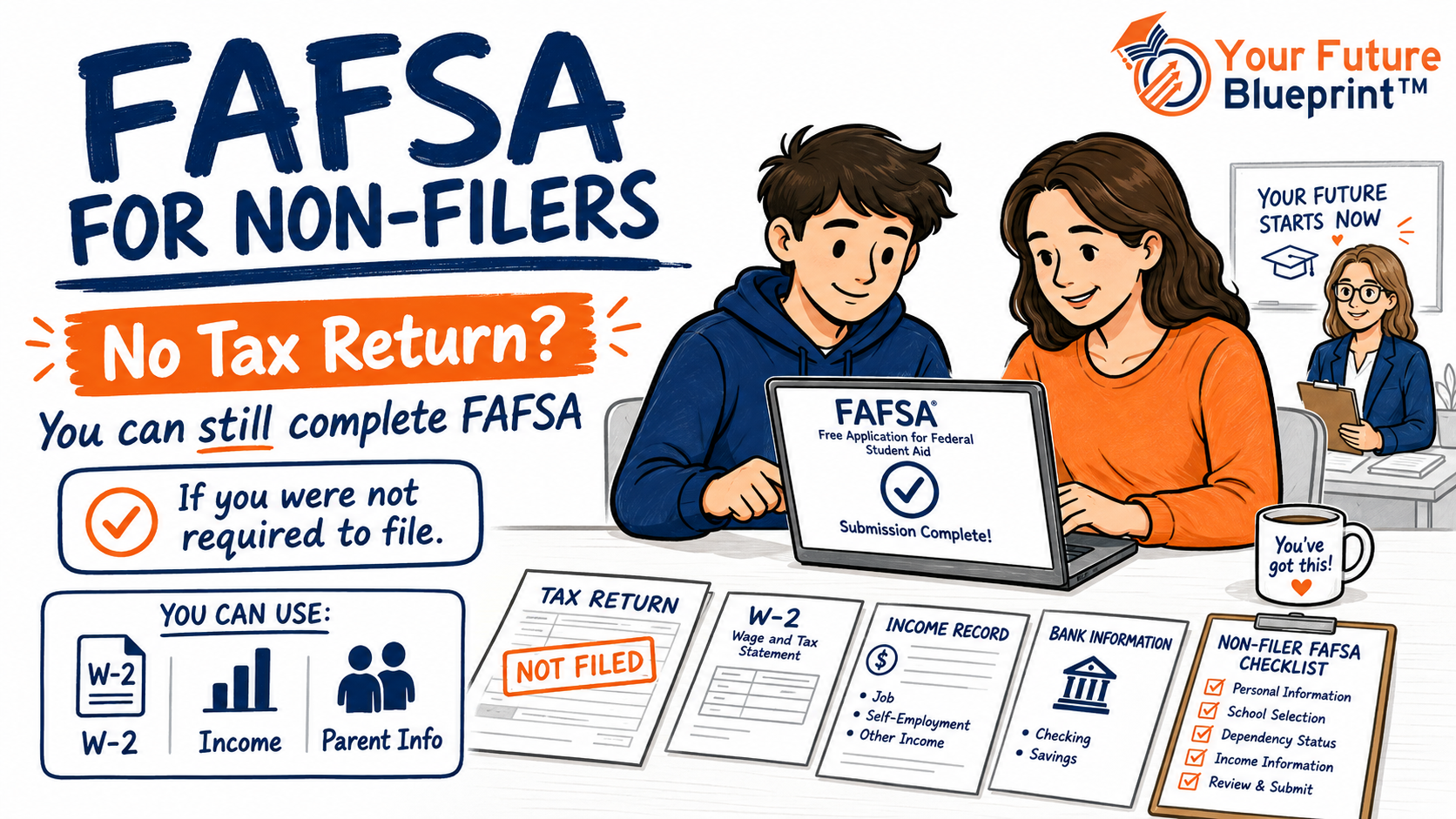
If a student or required contributor did not file a federal tax return, review FAFSA for Non-Filers to understand how non-filing situations can affect FAFSA completion without assuming an opt-out is necessary.
Official Links and Sources
Indiana State Financial Aid – FAFSA Requirement and Waiver
Provides Indiana’s current explanation of the April 15 requirement, family and student opt-out options, school waivers, and access to the current FAFSA Waiver Form. Indiana.gov
Indiana General Assembly SEA 167-2023 Enrolled Act
Provides the enacted statutory language establishing Indiana’s FAFSA filing requirement, April 15 deadline, covered schools, and waiver provisions.
U.S. Department of Education Official FAFSA Application
Official federal destination for completing the FAFSA and selecting the correct aid year.
Disclaimer: This article provides general educational information about Indiana’s FAFSA filing and opt-out requirement. State law, waiver procedures, financial aid deadlines, and school processes may change, and individual circumstances can differ. Confirm current requirements with the student’s high school, the Indiana Commission for Higher Education, Federal Student Aid, and the appropriate college financial aid office.
.png)

.png)
.png)