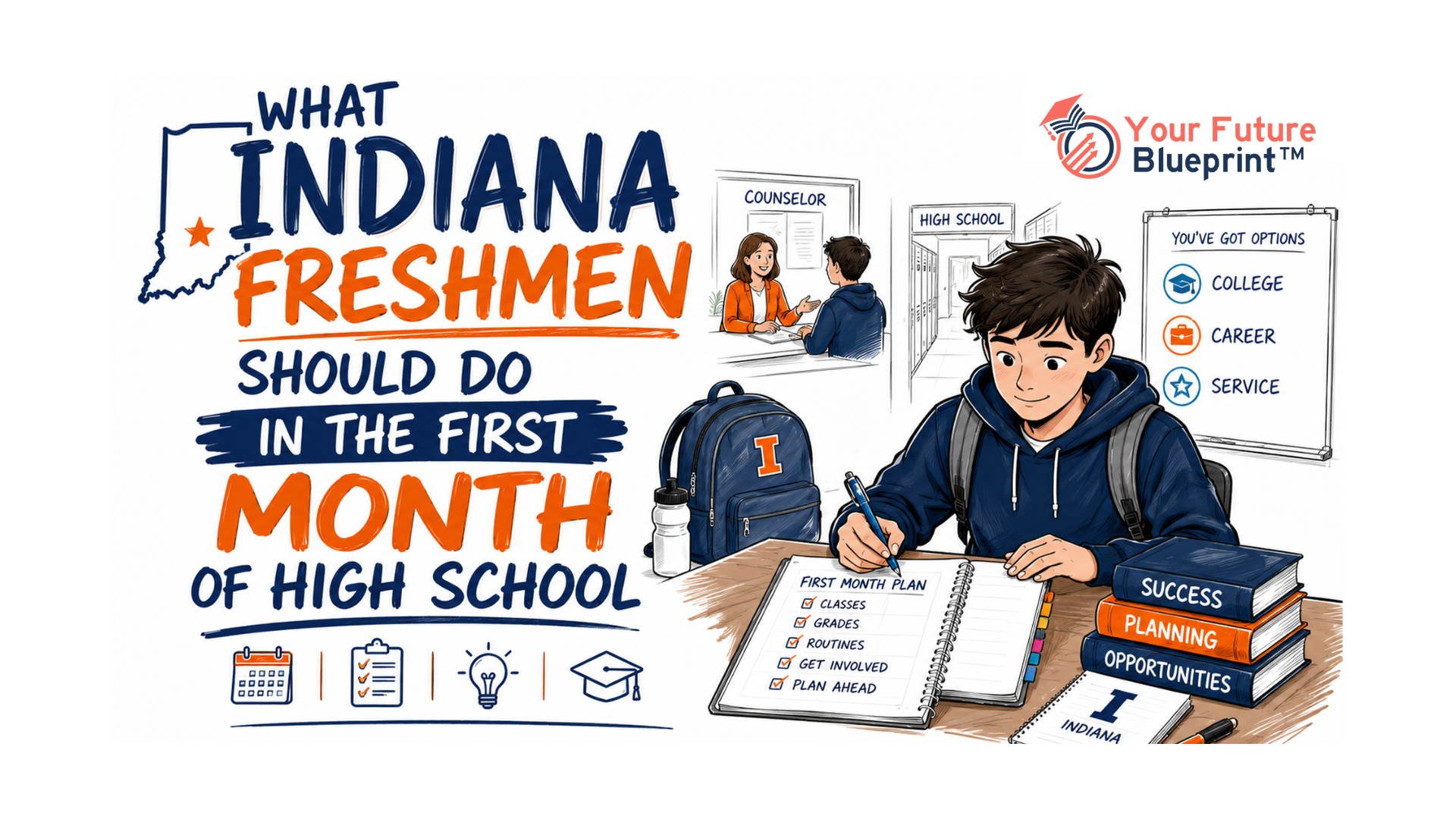
What Indiana Freshmen Should Do in the First Month of High School
The first month of high school matters, but not because you need to have the next four years completely figured out.
For an Indiana freshman, the better goal is much simpler: learn how your school works, understand what you are working toward, build routines that help you keep up, and start asking questions before small problems become bigger ones.
That is especially important for students in the Class of 2029 and later. Indiana has introduced new statewide diploma requirements for these students, including more flexibility to build a high school experience around college, employment, or enlistment and service goals.
You do not need to choose your entire future during freshman year. In fact, Indiana's new system is designed to allow students to adjust their plans as their interests and goals change.
Here is what deserves your attention during the first few weeks.
Start by Understanding Your Graduation Plan
One of the most useful things you can do early in ninth grade is find out exactly which graduation requirements apply to you.
Indiana's new diploma requirements apply statewide beginning with the Class of 2029. The new Indiana Diploma requires at least 42 credits across areas including English, mathematics, science, technology and engineering, social studies, physical education and health, personalized electives, and college and career preparation.
The diploma also gives students opportunities to pursue Readiness Seals connected to three broad directions:
- Enrollment
- Employment
- Enlistment and Service
These are not decisions you have to lock in during your first month of high school. The Readiness Seal system is designed to allow students to change direction as their plans develop.
Your first step should simply be understanding what your current schedule is helping you complete.
Ask your counselor questions such as:
- Which diploma requirements apply to my graduating class?
- What credits am I earning this year?
- Are there courses I should plan ahead for?
- What options will I have for electives, career and technical education, dual credit, or other programs?
- How does my school help students plan for Readiness Seals?
Your school's course offerings and scheduling process may differ from those at another Indiana high school, so use statewide requirements as a starting point and your counselor as a resource for building your individual plan.
Make Sure Your Schedule Makes Sense
During the first few weeks, look at your schedule as more than a list of classes.
Know what each class is, what credit it provides, and what your teacher expects.
If something looks wrong or you are unsure why you were placed in a particular course, ask early. Your school may have its own procedures and deadlines for schedule changes, so do not assume you can wait until later in the semester.
This does not mean trying to create the "perfect" freshman schedule. It means making sure you understand the schedule you already have.
For example, you might discover that your school offers career and technical education (CTE), advanced courses, college-credit opportunities, or specific course sequences that require planning ahead. You may not take those courses as a freshman, but knowing they exist can help you make better choices later.
Learn How Grades Work Before You Need to Fix Them
Freshman year is a good time to stop thinking only about individual assignments and start paying attention to the bigger picture.
Find out:
- Where your school posts grades
- How often teachers update them
- How missing work is handled
- Whether teachers offer extra help
- How absences affect assignments
- How your school calculates your grade point average (GPA)
Then check your grades regularly.
The goal is not to panic over every point. It is to notice patterns.
If you receive a low grade on one assignment, find out what went wrong. If you repeatedly struggle with the same type of work, that is a stronger signal that you may need help.
A useful question for a teacher is, "What should I work on first to improve in this class?"
That gives you something specific to act on.
Build a System for Keeping Track of Your Work
High school often gives students more responsibility for managing assignments, deadlines, activities, and communication.
You do not need a complicated productivity system. You need one that you will actually use.
That might be:
- Your school's learning management system
- A paper planner
- A calendar app
- A simple weekly assignment list
Choose one main place to track what needs to be done.
At least once a week, look ahead instead of only checking what is due tomorrow. A project that seems manageable when you have seven days can become stressful when you discover it the night before.
Also learn where teachers post announcements, course materials, and schedule changes. Missing information because you did not know where to look is a preventable problem.
Figure Out Where to Get Help
Do not wait until you are failing a class to learn where academic support comes from.
During your first month, identify the people and resources available at your school. Depending on the school, those might include teachers, counselors, tutoring programs, academic support periods, librarians, special education staff, English learner services, coaches, or other student-support professionals.
If a class is already confusing, talk with the teacher.
If your overall schedule or graduation plan is confusing, talk with your counselor.
If you need accommodations or another form of student support, find out which staff member at your school coordinates those services.
Knowing whom to ask is a skill in itself.
Get Involved, but Give Yourself Room to Adjust
Clubs, athletics, student organizations, career programs, music, arts, service activities, and other opportunities can make high school more meaningful.
Freshman year is a good time to explore.
It is not necessary to join everything.
Consider trying one or two activities that genuinely interest you. Give yourself enough time to see whether you enjoy them and whether they fit with your academic workload.
Activities can help you develop friendships, interests, leadership skills, career awareness, and experience outside the classroom. But an activity is useful only if it makes sense for you.
You do not need to build a college résumé during your first month of ninth grade.
Start Exploring Your Options Without Choosing Your Entire Future
You may already know what you want to do after high school. You may have no idea. Both situations are normal.
Indiana's diploma structure gives students room to connect high school with different postsecondary goals, including higher education, employment, and enlistment or service.
Freshman year can therefore be a time for exploration rather than a final decision.
Pay attention to subjects you enjoy and subjects you do not. Ask what career and technical education pathways your school offers. Learn whether your high school provides dual-credit courses or opportunities connected to the Indiana College Core.
The Indiana College Core is a block of 30 college credit hours of general education coursework that transfers among Indiana's public higher education institutions and some private or independent colleges. It can be a valuable option for some students, but freshmen do not need to decide immediately whether they will pursue it.
The important step now is learning what opportunities your school offers and whether any require you to plan your courses in advance.
If You Are a 21st Century Scholar, Know Your Responsibilities
If you are already enrolled in Indiana's 21st Century Scholars program, freshman year is a good time to make sure you understand what comes next.
The program provides eligible Indiana students with a pathway toward state financial aid for college, but Scholars have responsibilities during high school, including completing the Scholar Success Program.
ScholarTrack is Indiana's online system students use for state financial aid information and Scholar progress.
If you are unsure whether you are enrolled, whether your information is correct, or what activities you need to complete, check with your school counselor and the current official 21st Century Scholars resources.
Do not wait until senior year to discover that you misunderstood a program requirement.
Pay Attention to Attendance From the Beginning
Showing up consistently makes almost everything else easier.
Missing school can mean missing instruction, assignments, announcements, group work, labs, or other experiences that may be difficult to recreate later.
If you do need to miss school, learn your school's process for reporting absences and making up work. Attendance rules and procedures can vary locally, so check your school's handbook rather than assuming every Indiana high school handles absences the same way.
Students considering Readiness Seals should also understand that attendance can become relevant to certain seal requirements. That is another reason to discuss your graduation plan with your counselor rather than waiting until junior or senior year.
Do a Simple Check-In at the End of the First Month
After three or four weeks, give yourself a short progress check.
Ask yourself:
Academics: Do I understand what is expected in each class?
Organization: Do I have a reliable way to track assignments and deadlines?
Grades: Do I know where to check my progress?
Support: Do I know whom to ask if I need help?
Graduation: Do I understand which Indiana diploma requirements apply to my class?
Activities: Have I found anything I would like to explore outside class?
Future planning: Do I know at least one opportunity at my school that I want to learn more about?
You do not need perfect answers.
The purpose of this check-in is to identify what you should ask about next.
What Can Wait
There are also several things you do not need to solve during your first month of freshman year.
You do not need to know your college major.
You do not need a final college list.
You do not need to choose a lifelong career.
You do not need to know exactly which Readiness Seal you will ultimately pursue.
You do not need to fill every free hour with activities.
And you do not need to map every class through senior year without ever changing the plan.
What you do need is enough information to avoid accidentally closing off an option you might want later.
That is why early conversations with your counselor can be useful. You can build a flexible plan now and adjust it as you learn more about yourself.
Your First Month Is About Building a Foundation
A strong freshman year does not begin with having every answer. It begins with knowing where to find reliable answers.
Understand your classes. Learn your school's systems. Keep track of your work. Ask for help when you need it. Explore a few opportunities. Most importantly, learn what Indiana's graduation requirements mean for your graduating class and how your school is implementing them.
Then keep revisiting your plan.
Your interests may change between freshman and senior year. Your goals may change too. Indiana's current diploma framework recognizes that possibility.
The goal of your first month is not to decide your entire future.
It is to start high school with enough information, support, and good habits to make your next decision well.
Best Next Step
Ready to take the next step in your college planning journey? Explore the training track that best fits where you are right now.
Get practical, step-by-step guidance to help you move forward with confidence.
OFFICIAL LINKS AND SOURCES
Indiana Department of Education — New Indiana Diploma
This is the primary official destination for current Indiana Diploma requirements, Readiness Seals, implementation guidance, and related resources.
Indiana Department of Education — Graduation Pathways
Useful for understanding Indiana's Graduation Pathways framework and applicable requirements.
Indiana Commission for Higher Education — State Financial Aid Programs
Official information about Indiana programs including the 21st Century Scholarship
Indiana Commission for Higher Education — Indiana College Core / Credit Transfer
Official information about the 30-credit Indiana College Core and how the completed Core transfers among Indiana public higher education institutions.
Learn More Indiana — 21st Century Scholars Grade 9 Guide
Official student-facing guidance for ninth-grade 21st Century Scholars, including Scholar responsibilities, ScholarTrack, and high school planning.
Disclaimer: This article provides general educational information for Indiana students. Graduation requirements are statewide, but course offerings, schedules, attendance policies, and other procedures can vary by school. Confirm your individual graduation plan and current requirements with your school counselor and official Indiana resources.

.png)