Talking about college money can feel uncomfortable.
You may be worried that asking about income, savings, or family support will sound demanding. Your parents may also be worried about disappointing you or discussing financial information they normally keep private.
The purpose of this conversation is not to investigate your parents’ finances or pressure them to pay. It is to understand what may be realistic so your family can compare college options, prepare financial aid forms, and avoid making plans based on assumptions.
A respectful conversation will not answer every question immediately. It can, however, give everyone a clearer starting point.
Review and update information
Reviewed for: 2026–27 FAFSA cycle
Last reviewed: July 2026 | Review type: Policy-sensitive
What changed in this update:
- The article clarifies that being identified as a FAFSA contributor does not make a parent responsible for paying the student’s education costs.
- Parent information is generally required when a student is considered dependent for FAFSA purposes. Different instructions may apply to independent students or students experiencing unusual family circumstances.
- The CSS Profile is required only by participating colleges, universities, and scholarship programs. Students should check each institution’s financial aid requirements and deadlines.
- The video’s statement that early planning can “save thousands” has been replaced in the article with more careful guidance. Planning early can help families compare estimated net costs and reduce financial surprises, but it does not guarantee a specific amount of savings. Financial aid requirements, college costs, application processes, and institutional deadlines can change. Verify important details through the official resources listed below.
Quick Answer
Start the college money conversation by asking what your family may realistically be able to contribute—not by demanding exact income or savings information. Discuss estimated college costs, financial aid responsibilities, the student’s expected contribution, and which choices the family is comfortable considering.
The goal is to create a working plan that can be updated as college prices and financial aid offers become clearer.
Key Takeaways
- Choose a calm time instead of starting the conversation during an argument or stressful moment.
- Ask for a realistic planning range rather than demanding every financial detail.
- Do not assume that wanting you to attend college means your parents can pay the full cost.
- Students and parents may need to work together on financial aid applications.
- Update the plan after receiving actual financial aid offers and college cost information.
Who This Is For
Students: Learn how to ask practical college money questions without making the conversation feel like a confrontation.
Parents: Use the conversation to explain what support may be possible and what financial limits the family needs to consider.
Counselors: Share a neutral conversation framework with students and families who are beginning the college planning process.
Why the Money Talk Matters
College decisions can involve more than tuition. Families may also need to consider required fees, housing, food, transportation, books, supplies, health insurance, and personal expenses.
A college’s advertised price is not necessarily what every student will pay. Grants and scholarships may reduce the cost, while loans and work-study affect how the remaining amount may be covered. A school’s net price calculator and financial aid office can provide estimates, but the final numbers usually become clearer after admission and financial aid offers are released.
Discussing money early helps your family identify which questions still need answers. It may also help you build a college list that includes financially realistic options instead of waiting until the final decision deadline to discuss cost.
The Goal Is a Planning Range, Not an Audit
You do not need to ask your parents to disclose every account balance during the first conversation.
Start with questions that help you understand the general plan:
- Is there an amount the family may be able to contribute each year?
- Is that amount a firm limit or an early estimate?
- Would the amount change if I lived at home?
- Is the family comfortable considering parent loans?
- Would I be expected to borrow student loans?
- How much should I plan to contribute through work or savings?
- Are there other children or family responsibilities that must be considered?
- Are there types of colleges or living arrangements that would not be affordable?
Your parents may not know the answers yet. That is okay. Record the questions and agree on what information each person will research.
Prepare Before Starting the Conversation
Arriving prepared can make the discussion more productive.
Before the meeting, gather:
- A preliminary list of colleges, career schools, apprenticeship programs, or other options you are considering
- Each school’s estimated cost of attendance
- Net price calculator estimates when available
- Notes about scholarships or grants you plan to research
- An estimate of your own savings or possible work contribution
- Questions about the FAFSA or CSS Profile
- Important financial aid and admission deadlines
Do not present a college’s published price as the final amount your family will owe. Use estimates as a starting point and label them clearly.
Choose the Right Time and Setting
Avoid beginning the conversation when someone is rushing, exhausted, paying bills, or already upset.
You might say:
“I know talking about money can be uncomfortable, but college decisions are coming up. Could we choose a time to talk about what may be financially realistic?”
Another option is:
“I am not asking you to promise anything today. I want to understand our starting point so I can research colleges and financial aid more responsibly.”
Using “I” statements can help you explain your goal without blaming or pressuring anyone.
Questions Worth Asking
You may not need to ask every question in one meeting. Choose the questions that are most useful for your current stage of planning.
Family budget questions
- Is there a yearly amount our family may be able to contribute?
- Does that amount include tuition, housing, transportation, and other expenses?
- Would living at home change what may be affordable?
- Are there financial limits I should use when building my college list?
Student responsibility questions
- How much am I expected to contribute?
- Would working during high school, summer, or college be part of the plan?
- Are there limits on how much student loan debt we are comfortable considering?
- What scholarships, grants, or lower-cost options should I research?
Financial aid questions
- Who will help complete the FAFSA?
- Does any school on my list require the CSS Profile?
- Which documents or accounts should we prepare?
- When should we meet again to review deadlines?
- Who will contact the financial aid office when something is unclear?
Decision-making questions
- Will we compare colleges based on the final net cost rather than the advertised price?
- How will we decide whether a more expensive option is financially manageable?
- What alternatives should we consider if the first-choice college is not affordable?
Listen Before Offering Solutions
Your parents may be worried about retirement, debt, medical costs, employment changes, supporting other family members, or financial obligations you do not know about.
You do not need to solve those concerns during the first conversation. Listen carefully and avoid treating a financial limit as a lack of support for your goals.
You can respond with:
“Thank you for being honest. I would rather understand the limit now so we can look at realistic options.”
It is also reasonable for parents to keep some financial details private. Students generally need enough information to plan and complete required applications—not unrestricted access to every part of the family’s finances.
Understanding FAFSA Contributors
Dependent students generally must provide parent information on the Free Application for Federal Student Aid, or FAFSA. A parent who is required to provide information is called a contributor.
Being a contributor does not make that parent legally responsible for paying the student’s college costs. The contributor’s role is to provide required information, give consent for certain federal tax information to be transferred or used, and sign their portion of the form.
Students should follow the FAFSA instructions to determine which parent or parents must participate. Rules can differ based on marital status, living arrangements, financial support, and other circumstances.
Understanding the CSS Profile
Some colleges and scholarship programs require the CSS Profile in addition to the FAFSA. It may request more detailed information about family income, assets, expenses, and household circumstances.
Not every college uses the CSS Profile. Students should check the official participating-institution list and each college’s financial aid website before beginning the application.
Families may need tax returns, income records, information about assets, and bank statements when completing the CSS Profile. Requirements involving divorced, separated, or noncustodial parents may also differ by institution.
Create a Shared College Money Plan
End the conversation by recording the decisions that were made and the questions that remain unanswered.
Your plan might include:
Student responsibilities
- Research scholarship opportunities.
- Complete the student sections of financial aid applications.
- Compare college costs and financial aid offers.
- Track deadlines.
- Contribute an agreed amount from work or savings.
Parent or support-adult responsibilities
- Create or confirm required financial aid accounts.
- Gather the financial documents required for applications.
- Complete contributor sections by the agreed deadline.
- Explain the family’s current planning range.
- Review borrowing decisions before anything is accepted.
Shared responsibilities
- Review net price calculator estimates.
- Contact financial aid offices with questions.
- Compare financial aid offers carefully.
- Discuss transportation, housing, and other indirect costs.
- Update the plan when new information becomes available.
This conversation should be treated as the beginning of a process, not a one-time decision.
What to Watch For
Assuming the published price is the final price
The advertised cost does not account for the individual grants and scholarships a student may receive. Use school-specific net price calculators for early estimates and compare actual financial aid offers before making a final decision.
Assuming financial aid will cover everything
Financial aid offers vary by student and institution. Some offers may include loans or work-study in addition to grants and scholarships.
Treating loans like discounts
Loans must generally be repaid. Separate grants and scholarships from loans when reviewing an aid offer.
Waiting until a decision deadline
Starting the conversation earlier gives the family more time to compare options, ask questions, and consider alternatives.
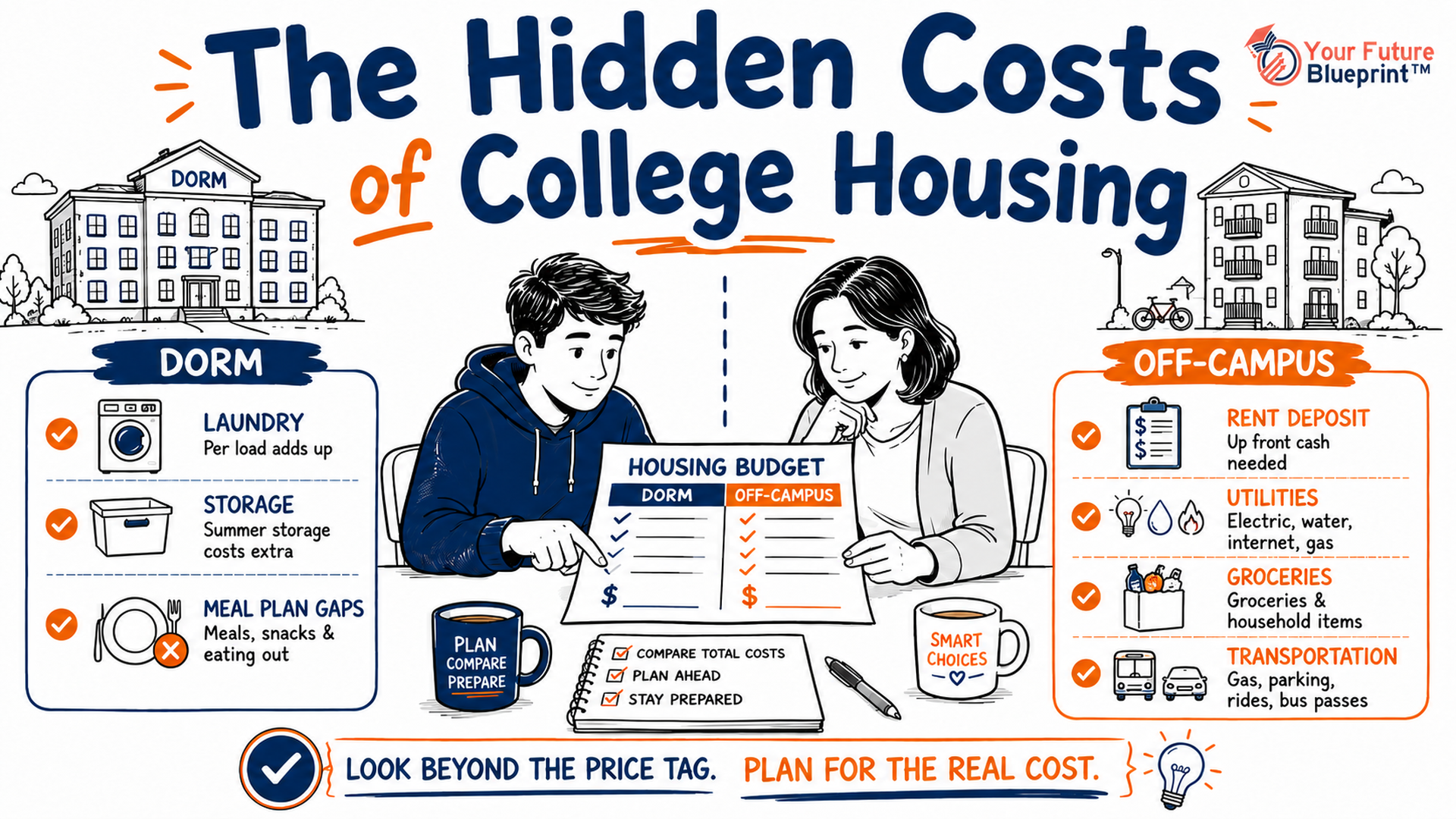
Comparing tuition only
Housing, food, transportation, fees, books, supplies, and personal expenses can significantly affect the complete cost.
Sharing account credentials
Students and contributors should follow official account instructions. Do not exchange passwords or pretend to be another person when completing financial aid forms.
What To Do If This Happens
Your parents avoid the conversation
Ask for a short meeting focused on one question instead of trying to solve the entire college plan.
For example:
“Could we spend 20 minutes this weekend talking only about the general amount we should use when comparing colleges?”
A parent says the family cannot contribute
Thank them for being honest. Ask your school counselor or college financial aid offices for help identifying options with a lower estimated net cost.
You may need to consider:
- Colleges with stronger grant aid
- Community college transfer pathways
- Living at home
- Work and savings
- Employer-supported education
- Apprenticeships or other paid training
- Taking additional time to prepare financially
These options should be evaluated based on your academic, career, financial, and personal circumstances.
The conversation becomes emotional
Pause the discussion rather than forcing an immediate decision.
You might say:
“I do not want this to become an argument. Can we take a break and return to it after we have had time to think?”
A parent will not participate in the FAFSA
Do not guess, enter false information, or use another person’s account.
Speak with your school counselor and contact the financial aid office at each college you are considering. Explain the situation privately and ask which official process applies. The options available can depend on the student’s circumstances.
Your family situation is complicated
Divorce, separation, loss of contact, abandonment, homelessness, foster care, incarceration, abuse, or other unusual circumstances may affect which information is required.
Do not assume that the standard parent instructions apply. Use the official FAFSA guidance and speak privately with a school counselor or financial aid administrator.
Your family’s finances have changed
If a job loss, medical event, death in the family, divorce, or another major change is not reflected accurately in the financial information used for an aid offer, contact the college’s financial aid office.
Ask whether the college has a professional judgment, special-circumstances, or financial aid appeal process. Each institution may require different documents.
What To Do Next
- Schedule a calm 20- to 30-minute conversation.
- Bring estimated costs for two or three possible schools or pathways.
- Ask for a realistic yearly planning range.
- Agree on the student’s expected contribution.
- Identify who will complete each part of the FAFSA or CSS Profile.
- Create a list of missing information and deadlines.
- Schedule a second conversation after financial aid estimates or offers become available.
Official / Trusted Links
Federal Student Aid — FAFSA Application
Use the official FAFSA website to complete or manage the FAFSA form.
Federal Student Aid — Steps for Parents
Review contributor responsibilities and the steps parents may need to complete.
Federal Student Aid — Reporting Parent Information
Use this guidance to determine which parent information may be required.
Federal Student Aid — Understanding College Costs
Use this resource to learn about cost of attendance, net price, and school comparison questions.
College Scorecard
Compare information about college costs, financial aid, completion, debt, and student outcomes.
College Board — CSS Profile
Check participating institutions and review the application process.
Related Your Future Blueprint Resources
Related training track: FINANCIAL AID TRACK
Best Next Step
Ask your parent or support adult to schedule one short college money meeting. Bring cost estimates for a few possible schools and leave the conversation with a preliminary budget range, a list of financial aid responsibilities, and a date for the next discussion.
Your school counselor and college financial aid offices can help answer questions that your family cannot resolve alone. Your Future Blueprint™ can serve as an additional planning resource as you organize the next steps.
Counselor Share Note
This article is designed to be shared with students and families as a general educational resource. Families should still confirm details with official sources, school counselors, financial aid offices, college representatives, school administrators, or other trusted advisors.
Sources & References
Last Reviewed
July 2026
Review cycle: 2026–27 FAFSA cycle
Recommended review frequency: Annual and whenever FAFSA or CSS Profile requirements change
Disclaimer
This content is for general educational purposes only and does not constitute financial, legal, tax, academic advising, or professional advice. Students and families should consult with school counselors, financial aid offices, college representatives, school administrators, official agencies, or trusted advisors before making final decisions.
No personal student information is collected or stored when accessing free content through verified K–12 school platforms. Any optional tools that collect user-provided information should be reviewed against the platform’s current Privacy Policy and Terms of Use.
View Transcript

Transcript note:
This transcript reflects the original video content. Some statements have been clarified or updated in the reviewed article above. Please use the reviewed article and official links for current financial aid guidance.
Imagine asking your parents how much money they make or what they have saved for your future. It is awkward, right?
That is exactly why the college money talk feels so difficult—but it is a conversation you cannot skip. This is not just their burden. It is your future. Learning how to have this conversation is an important step toward financial independence.
The best time for this talk was yesterday. The second-best time is now.
Arrive prepared because this is your future. Early budgeting gives you clarity about affordable college options and may help you avoid costly surprises later.
You may need your parents’ financial information for the FAFSA or CSS Profile. This should be an ongoing conversation rather than something you discuss only once.
Choose a calm moment and a neutral setting.
Start by acknowledging the discomfort:
“I know talking about money can be tough, but college is coming up, and I want to understand how we can make this work.”
Use “I” statements and listen more than you talk. Your parents may have fears or concerns they need to express.
Your parent might say, “We will need to fill out the FAFSA.”
You might be thinking, “That sounds like a dance move.”
You will want to ask:
“What is our family’s realistic college budget range?”
“What are your expectations for my contribution?”
“What kind of support can you offer?”
Do not assume that wanting you to attend college means your parents can pay for it. Financial surprises can derail plans.
Remember that after you turn 18, you should not automatically assume that family financial support is guaranteed. Treat any support with appreciation.
Look for ways to contribute your share through scholarships, part-time work, savings, or financially practical choices such as beginning at a community college when that option fits your goals.
This talk is not one-and-done. It is the beginning of a plan.
Follow up on the actions you agreed upon, such as researching scholarships or completing the FAFSA or CSS Profile together.
When your parents see you taking ownership and acting responsibly, it can build trust and help everyone work together. Your school counselors are also important partners in this process.
It is a tough conversation, but it is worth having.
Disclaimer
This content is for educational purposes only and does not constitute financial, legal, or professional advice.
Students and families should consult with school counselors, financial aid offices, or trusted advisors before making final decisions.
No personally identifiable student information is required to access free content. When students choose to use optional platform features, they or their parents may provide basic information for planning purposes rather than school data.
Personal information provided through platform tools should be stored and handled in accordance with the current Privacy Policy and Terms of Use.