What Does College ROI Really Mean?
College ROI is not just a salary calculation. A useful comparison looks at what a student is likely to pay, how much they may borrow, whether they are likely to finish, and what career opportunities the program can realistically support.
This guide provides a practical framework for comparing cost, career outcomes, risk, and alternatives before making a major education investment.
Reviewed for: 2026 Career Data Review
Last reviewed: June 2026 | Review type: Data-sensitive
What changed in this update:
- No major changes identified during this review.
- Links and official resources were reviewed for accuracy.
- Time-sensitive details should still be verified before major decisions.
Important: College costs, salary data, labor market demand, and graduate outcomes can change over time. Verify important decisions using current official sources.
Quick Answer
Return on Investment (ROI) helps students evaluate the value they may receive from an educational pathway compared to the money, time, and effort required. A strong ROI does not automatically mean choosing the least expensive option or the highest-paying career. It means understanding costs, opportunities, personal goals, and long-term outcomes before making a decision.
Key Takeaways
- ROI measures what you gain compared to what you invest.
- Salary alone does not determine whether a career path provides strong value.
- Time spent in school has financial value and should be considered.
- Different colleges can produce very different financial outcomes for the same major.
- Good decisions balance affordability, career opportunities, and personal goals.
Who This Is For
Students: Learn how to compare college and career options more effectively.
Parents: Understand how education costs and career outcomes work together.
Counselors: Support conversations about long-term planning and informed decision-making.
Why ROI Matters
Many students spend months researching colleges without ever asking one important question:
"What am I likely to receive in return for this investment?"
College, trade school, certification programs, apprenticeships, and workforce training all require investments of time, money, effort, and opportunity.
ROI, or Return on Investment, provides a framework for evaluating those investments.
Thinking about ROI does not mean reducing every decision to money. It means understanding how educational choices may affect future opportunities, finances, and career options.
What Is Return on Investment?
Return on Investment measures what you receive compared to what you spend.
Imagine earning $30 from an after-school job but spending $20 on transportation and expenses. Your actual gain is only $10.
Education works in a similar way.
When evaluating college or career training, students should consider:
- Tuition and fees
- Housing costs
- Transportation expenses
- Books and supplies
- Lost income while studying
- Future earning potential
Looking only at the price of a program or only at future salary often provides an incomplete picture.
Start With Net Cost, Not Sticker Price
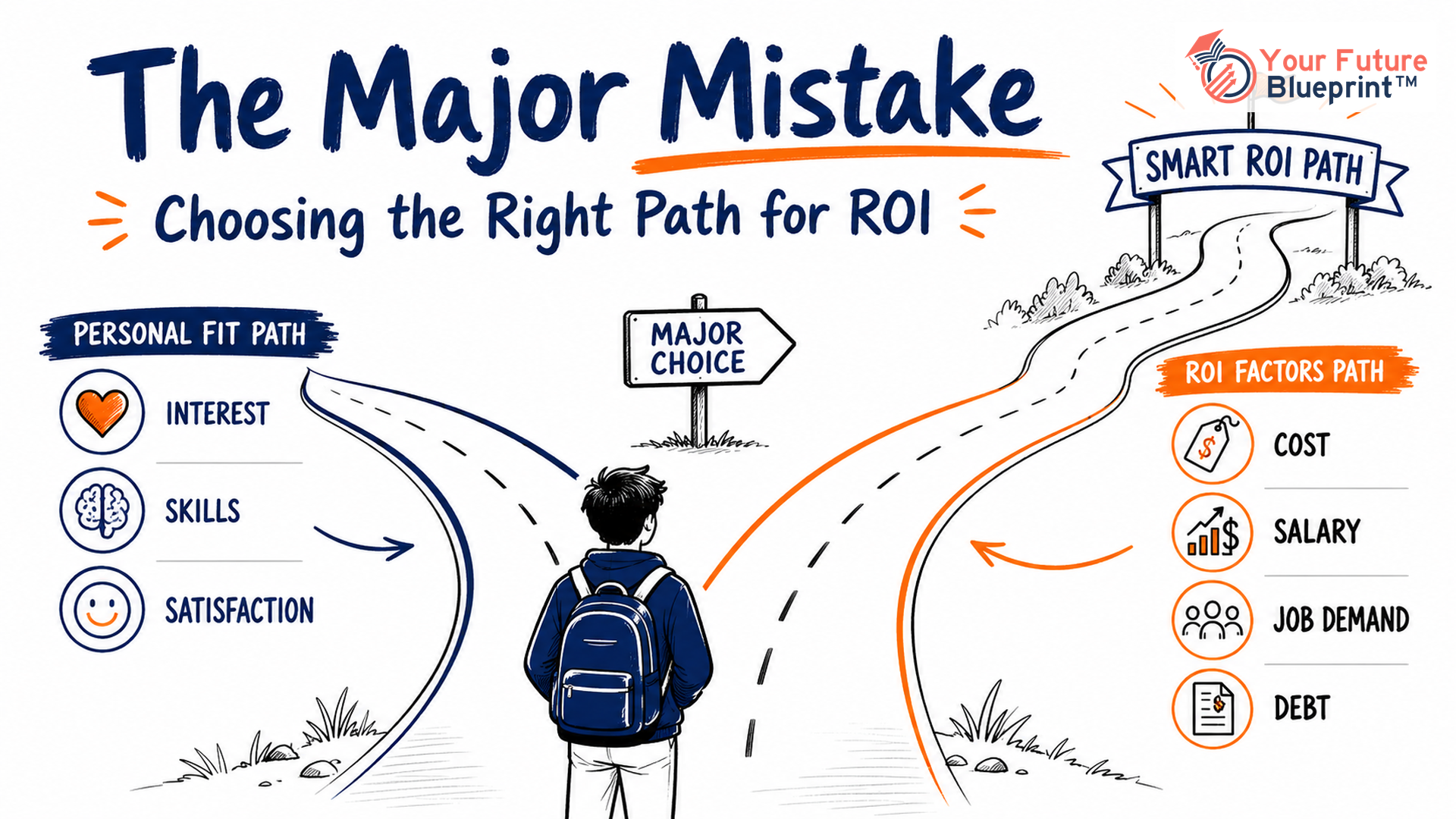
One common mistake is focusing entirely on salary numbers.
A career paying $45,000 annually may sound appealing. However, if significant student loan payments reduce available income, the practical financial picture changes.
Net ROI focuses on what remains after educational costs have been considered.
This approach encourages students to think beyond headline earnings and consider long-term financial stability.
Factor in Debt, Completion Risk, and Time to Degree
College ROI can change significantly when students consider debt, the likelihood of completing a program, and how long it takes to earn a credential.
A lower-cost program may still have financial risk if students take on substantial debt or do not finish. Time also matters because additional years in school can mean more education costs and delayed income.
When comparing options, students should look at student debt levels, graduation rates, total educational costs, and the time required to complete the program—not just expected salary
Time Is an Investment Too
Money is not the only thing students invest.
Time has value.
Economists refer to this as opportunity cost.
Opportunity cost represents what a person gives up when choosing one path instead of another.
Examples include:
- Years spent completing a degree
- Income delayed while attending school
- Additional education requirements before entering a profession
Two careers may eventually provide similar earnings, but one path may require significantly more time and expense before reaching that point.
Students who understand opportunity cost often make more informed decisions.
Compare Career Outcomes and Earnings Carefully
Many careers with strong ROI have one thing in common:
Employer demand.
When employers actively need workers, opportunities often increase.
Examples frequently include:
- Science
- Technology
- Engineering
- Mathematics
- Nursing
- Information Technology
- Accounting
- Skilled Trades
- HVAC
- Welding
This does not mean every student should pursue these fields.
It simply highlights the importance of understanding labor market demand when evaluating potential career paths.
Lower ROI Does Not Mean a Bad Choice
ROI is a useful planning tool, but it should never be the only factor.
Students have different goals, interests, values, and definitions of success.
Some fields may produce lower average earnings while still providing meaningful and rewarding careers.
The key is understanding the tradeoffs before making a decision.
Informed decisions are usually stronger than assumptions.
Graduate School Changes the Equation
Graduate education can create valuable opportunities, but it often increases both costs and time commitments.
Examples include:
- Master's degrees
- Doctoral programs
- Law school
- Professional healthcare programs
For some careers, advanced education is required.
For others, it is optional.
Students should evaluate:
- Total educational costs
- Expected earnings
- Employment demand
- Career requirements
- Long-term goals
The goal is not to avoid graduate school. The goal is to understand the investment involved.
The Same Major Can Have Different ROI at Different Colleges
Two students can study the same major and experience very different financial outcomes.
Factors that influence ROI include:
- Tuition costs
- Scholarships and grants
- Student debt levels
- Graduation rates
- Career placement outcomes
A lower-cost institution with strong outcomes may provide greater financial value than a more expensive alternative.
That is why comparing colleges matters just as much as comparing majors.
Check the Data Before Deciding
Students should rely on evidence whenever possible.
Official / Trusted Links
College Scorecard
Compare costs, graduation rates, and earnings outcomes.
U.S. Bureau of Labor Statistics Occupational Outlook Handbook
Explore career growth projections and salary information.
Georgetown University Center on Education and the Workforce
Research education and career outcomes.
College Board College Pricing Resources
Learn more about college costs and trends.
What To Watch For
- Making decisions based solely on salary.
- Assuming expensive colleges automatically provide better value.
- Ignoring opportunity costs.
- Overlooking scholarship and grant opportunities.
- Choosing a program without researching employment demand.
A Simple Framework for Comparing College ROI
- Identify education paths that interest you.
- Research costs, graduation rates, and career outcomes.
- Compare multiple schools offering similar programs.
- Discuss options with parents, counselors, and trusted mentors.
- Use reliable data sources before making major financial commitments.
College ROI Comparison Checklist
| Compare |
What to Check |
| Net cost |
Tuition, fees, housing, transportation, books, supplies, scholarships, and grants. |
| Student debt |
How much the student may need to borrow and how repayment could affect future finances. |
| Completion likelihood |
Graduation rates and whether students are likely to complete the program. |
| Time to degree |
How long the credential usually takes and how additional years may increase costs or delay income. |
| Career outcomes |
Employment demand, career placement information, and opportunities connected to the program. |
| Earnings |
Available wage or earnings information, viewed alongside costs and career requirements. |
| Alternatives |
Other colleges, apprenticeships, skilled trades, certifications, or training paths that could lead toward the same goal. |
Important: Earnings and wage data are estimates or averages based on available data. They do not guarantee what an individual graduate will earn. Actual outcomes can vary by location, employer, experience, education, industry, economic conditions, and other factors.
Compare Cost, Career Fit, and Your Options
If you want a broader framework for planning college costs, borrowing, and affordability, explore the College Money Blueprint to connect college choices with budgeting, financial aid, and long-term financial planning.
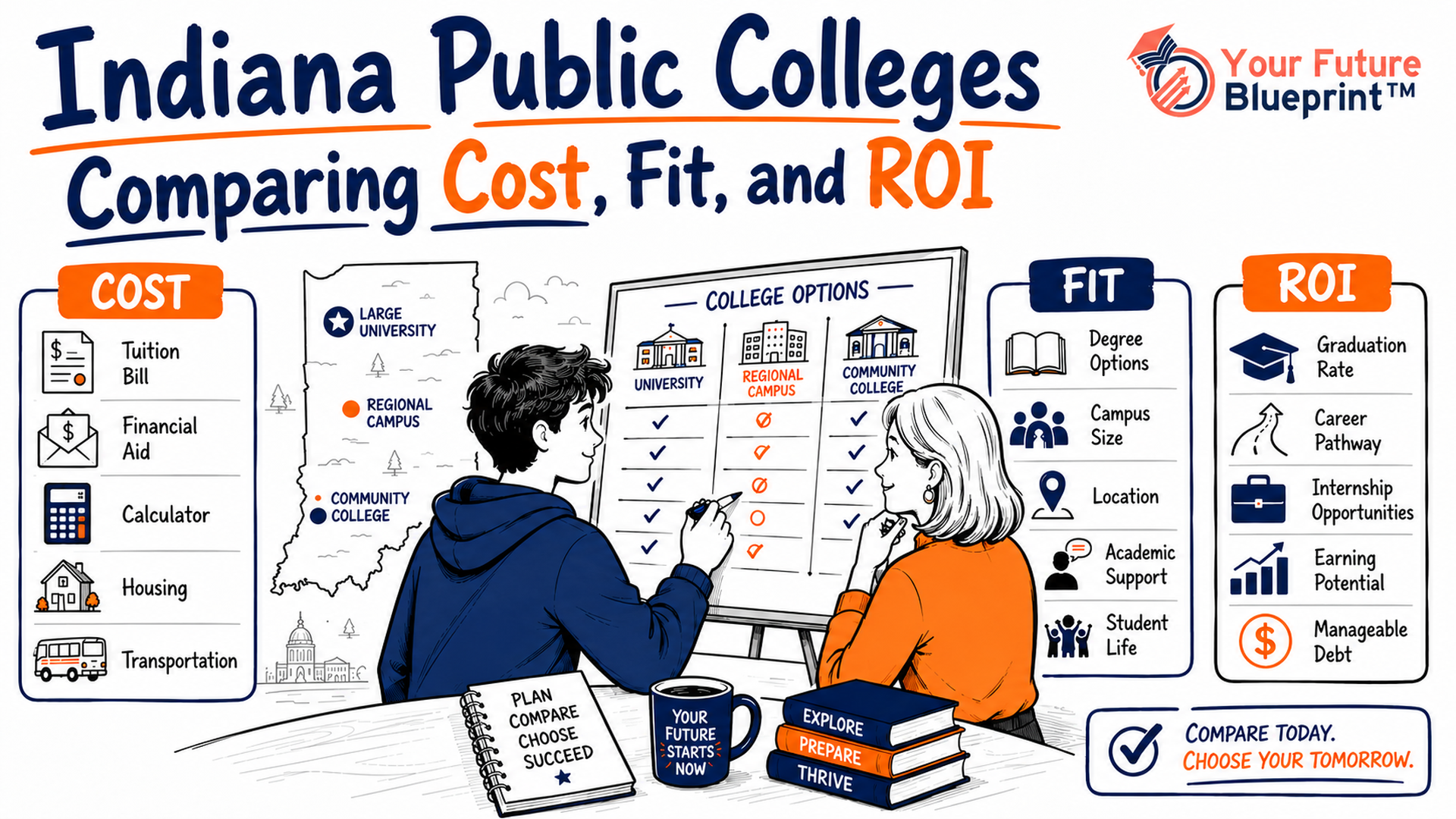
If you are comparing Indiana colleges, review Indiana Public Colleges: Comparing Cost, Fit, and ROI to look beyond tuition and compare overall cost, fit, completion factors, and career value.
Sticker price does not always show the full cost of attendance. Read The Hidden Costs of College to account for housing, transportation, supplies, and other expenses that can change the real cost of a degree.
College is not the only pathway worth comparing. Explore Skilled Trades ROI: Electrician, Plumber, Auto Tech, and More to compare training time, costs, earnings, and career opportunities across alternative pathways.
Best Next Step
Choose one career that interests you and compare at least three pathways that could help you reach it. Review program costs, financial aid opportunities, graduation outcomes, and labor market demand before making assumptions about value.
Ready for the next step? Explore the recommended track for step-by-step guidance:
Counselor Share Note
This resource may be shared with students and families as a general educational guide. Educational, financial, and career decisions should continue to involve school counselors, financial aid professionals, employers, college representatives, and other trusted advisors when appropriate.
Sources & References
Last Reviewed
JUNE 2026
Disclaimer
This content is for general educational purposes only and does not constitute financial, legal, tax, academic advising, or professional advice. Students and families should consult school counselors, financial aid offices, college representatives, employers, official agencies, or other qualified professionals before making major educational or financial decisions.
View Transcript

ROI: Real Costs, Real Careers
ROI means Return on Investment.
Think about it this way. If you earn money from an after-school job but spend much of it on transportation and expenses, your real return is what remains after those costs.
College works similarly. It is not only about what education costs. It is also about what you receive in return.
Net ROI focuses on what remains after paying educational expenses such as tuition and student loans.
For example, earning a salary after graduation may sound impressive, but educational debt and other costs can significantly affect take-home income.
Time is also part of the investment.
Students should consider opportunity cost, which includes years spent studying, delayed income, and additional education requirements.
Some fields often show strong ROI because employers actively need workers.
Examples include:
- Science
- Technology
- Engineering
- Mathematics
- Nursing
- Information Technology
- Accounting
- Skilled trades
- HVAC
Other majors may not produce the same average earnings.
That does not mean they are poor choices.
Students should simply understand the tradeoffs and make informed decisions.
Graduate school can increase both educational costs and time commitments.
For some professions, advanced degrees are required and may lead to greater career opportunities and earnings.
ROI can also vary by college.
Two students studying the same major may pay very different amounts depending on tuition, scholarships, grants, and financial aid.
Students should research reliable sources such as College Scorecard and salary databases before making decisions.
Good ROI is not simply about finding the cheapest option or the highest salary.
It is about balancing costs, career opportunities, and long-term financial stability.
College can be a valuable investment when students understand the costs, evaluate the potential returns, and make informed decisions.
Be smart, not sorry.