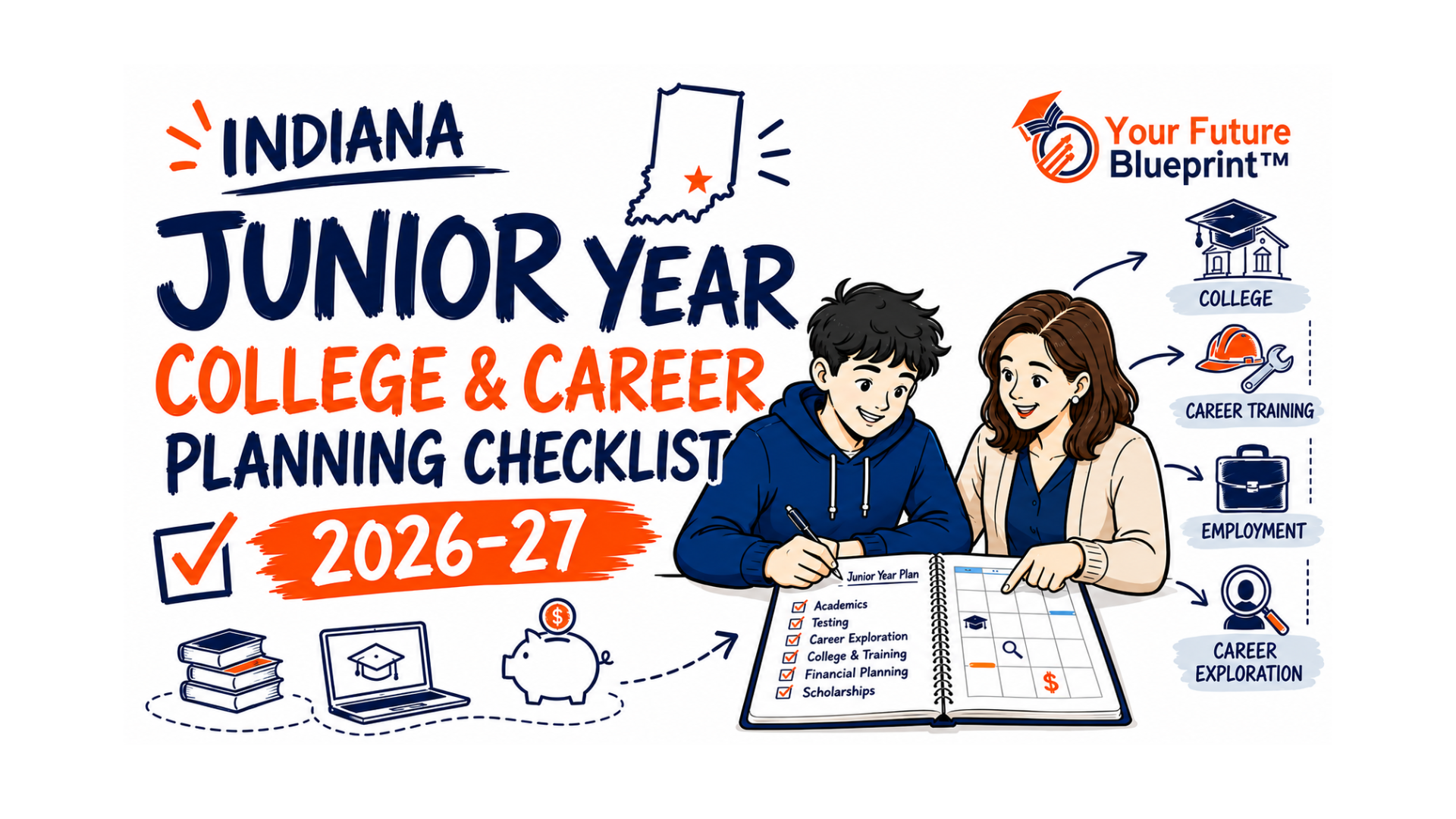
Indiana Junior Year College & Career Planning Checklist: 2026–27
Junior year is when high school planning starts turning into specific choices. For most Indiana students in grade 11 during 2026–27, that means the Class of 2028. Indiana’s existing graduation requirements and Graduation Pathways still apply through the 2028 cohort unless a school or student has opted into the new Indiana Diploma early. That makes one question especially important at the start of the year: Which diploma and pathway requirements are actually on your record?
You do not need to know your exact college major or career yet. The goal is to leave junior year with fewer unknowns, a realistic senior-year schedule, and a short list of next-step options you understand.
Review Your Graduation Progress Before Changing Your Schedule
Meet with your school counselor and review your transcript, diploma designation, earned credits, courses still required, and Graduation Pathways progress. Indiana’s current Graduation Pathways framework includes three parts: meeting diploma requirements, demonstrating employability skills, and completing a postsecondary-ready competency.
Ask specifically whether your school has opted you into the new Indiana Diploma. Do not assume that rules written for the Class of 2029 automatically apply to a Class of 2028 junior. Local course scheduling and documentation practices can also vary by school.
Before junior scheduling is locked, make sure your planned senior courses will cover remaining graduation requirements and any admission requirements for colleges or programs you may consider.
Treat Testing as a Planning Tool, Not the Whole Plan
Indiana uses the SAT as its grade 11 federal accountability assessment. For 2026–27, the SAT School Day testing window is March 1–12, 2027. Indiana also funds the optional PSAT/NMSQT for students in grades 10 and 11; the fall 2026 testing window is October 1 – 30, 2026.
Use your results to identify strengths and areas worth improving. If a college, scholarship, military pathway, or program has its own score expectations, verify them directly with that organization. Testing policies can differ, so one score should not determine your entire college or career list.
Complete Your Career Discovery Meeting and Use It Well
Indiana requires students in grades 11 and 12 to participate in at least a 30-minute, in-person Career Discovery Meeting with an approved postsecondary institution, intermediary, employer, or labor organization. A parent or guardian, or an emancipated student, may use the state’s opt-out process.
Do more than attend. Bring two or three questions: What education or training is usually required? What entry-level experience matters? What does advancement look like?
Use the answers to decide whether you should explore a campus visit, career and technical education course, work-based learning opportunity, apprenticeship, certification, or another experience. The purpose is not to choose one career permanently. It is to learn enough about your options to make your next decisions with better information.
Compare College Credit and Career Preparation Opportunities
Junior year is a good time to look closely at the advanced coursework and career-preparation options available through your school. These may include dual-credit courses, Advanced Placement classes, career and technical education programs, and work-based learning experiences.
One option worth understanding is the Indiana College Core, a 30-credit-hour block of college-level general education coursework. The completed Indiana College Core transfers to Indiana public colleges and universities and is also accepted by some private and independent institutions.
That does not mean every advanced course or college-credit opportunity is automatically the right choice. Ask how each course fits your remaining graduation requirements, possible college major or credential, senior-year workload, and future transfer plans.
If you are considering technical training or going directly into the workforce after high school, compare credentials, certifications, hands-on experience, apprenticeships, and employer connections with the same level of care you would use when comparing colleges.
Build a Short List of College and Career Options
By spring of junior year, try to identify several realistic possibilities instead of focusing on only one destination.
If college may be part of your plan, compare academic programs, admission requirements, campus environment, location, student support services, and likely costs. Visit campuses when practical and use each college’s official website to confirm current admissions and program information.
If you are still exploring careers, tools such as Indiana Career Explorer can help you connect your interests, work values, skills, education options, and possible occupations. Career assessments are most useful as a starting point for research—not as a final decision about what you should become.
Students considering apprenticeships, workforce training, military service, or employment can use junior year to learn what qualifications, testing, credentials, or application steps may be expected.
If you are a 21st Century Scholar, check your ScholarTrack account and make sure you are completing the activities assigned to your grade level. Junior-year Scholar Success activities include visiting a college campus, taking a college entrance exam, and searching for scholarships.
Start Financial Planning Before FAFSA Season
You do not need to complete the FAFSA during junior year, but you can start learning how college financial aid and college costs work.
Begin comparing more than tuition alone. College costs may also include required fees, housing, food, transportation, books, supplies, and personal expenses. Families can start discussing what they may reasonably be able to contribute and what amount of borrowing, if any, they would feel comfortable considering.
When comparing colleges, pay attention to net price, not only the published or “sticker” price. Grants and scholarships may reduce what some students actually pay, while loans are borrowed money that must be repaid.
Junior year is also a useful time to begin looking for scholarships. Keep track of eligibility requirements and deadlines, but verify scholarship information directly with the sponsoring organization before applying.
The FAFSA you eventually complete will correspond to the academic year in which you plan to attend college or another eligible postsecondary program. FAFSA deadlines can differ among the federal government, the State of Indiana, and individual colleges, so confirm the correct FAFSA cycle and deadlines when senior year begins.
Use Spring and Summer to Make Senior Year Easier
Before junior year ends, create a simple record of the activities and experiences you may need for future applications. Include employment, extracurricular activities, volunteer work, leadership, awards, certifications, dual-credit coursework, career experiences, and major school projects.
If you may need recommendation letters during senior year, think about which teachers, counselors, employers, coaches, or other appropriate adults know your work well. You do not need to collect every recommendation immediately, but knowing whom you may ask can prevent rushed requests later.
Keep important planning information in one organized place. This might include:
- An unofficial transcript
- Test information
- College and training program notes
- Scholarship information
- Activities and accomplishments
- Career interests
- Questions for your counselor
- Important senior-year deadlines
During the summer before senior year, narrow your list of college, training, apprenticeship, employment, or military options. Review official application requirements, visit programs or campuses when possible, and create a simple calendar for the deadlines you expect during senior year.
The goal is not to have your entire future decided before twelfth grade. A strong junior-year plan simply helps you enter senior year knowing what you still need to complete, what information you need to verify, and which options deserve a closer look.
Best Next Step
Schedule a junior-year planning meeting with your school counselor. Bring your transcript and a short list of the college, career, training, apprenticeship, employment, or military options you are considering.
Before the meeting ends, confirm these four things:
- Your current diploma and Graduation Pathways status
- Any credits or requirements you still need
- Your junior-year testing and career-planning responsibilities
- The most important steps to complete before senior year
You do not need to decide your entire future during junior year. The goal is to enter senior year with fewer unanswered questions and a clear, realistic plan.
Official Links and Sources
Indiana Department of Education — Graduation Pathways
Learn how Indiana Graduation Pathways fit into high school graduation planning, including the different components students may need to complete before earning their diploma.
Use this resource with your school counselor to review your graduation progress, identify requirements you have already completed, and confirm what still needs to be finished before senior year.
Indiana Department of Education — High School Assessment
Learn about Indiana high school assessments, including information related to SAT School Day and other assessments that may apply during high school.
Use this page to verify current testing information and dates.
Indiana Commission for Higher Education — Career Discovery Meetings
Learn how Indiana Career Discovery Meetings work for students in grades 11 and 12, including the purpose of the meeting and the types of organizations that may participate.
Use this information to prepare questions before your meeting about careers, education, training, credentials, apprenticeships, or workplace expectations.
Indiana Commission for Higher Education — Credit Transfer / Indiana College Core
Learn about the Indiana College Core and how eligible college-level coursework may transfer among Indiana institutions.
Use this resource when considering dual-credit or college-level courses.
Learn More Indiana — 21st Century Scholars
Learn about the 21st Century Scholars program and the college- and career-readiness activities Scholars may need to complete during high school.
If you are a 21st Century Scholar, use this resource together with ScholarTrack to review your junior-year activities and check your progress.
Indiana Department of Workforce Development — Career Exploration
Learn about Indiana career-exploration resources that can help you investigate occupations, education and training pathways, skills, and possible career directions.
Use career-exploration tools to create a short list of careers you want to research further.
Disclaimer: This article provides general educational and college-and-career planning information. Graduation requirements, testing dates, school policies, college admission requirements, financial-aid rules, and program requirements may change or vary by student, school, district, or institution. Confirm information that applies to your situation with your school counselor and the appropriate official college, program, or government agency.