Indiana students must complete more than course credits to graduate. Graduation Pathways combine diploma requirements with employability skills and postsecondary-ready competencies.
This guide explains the major parts of Indiana Graduation Pathways, how students can check their progress, and what families should verify with their school before senior year.
That may include college, career training, skilled trades, military service, employment, or another next step. The key is not to guess. Students should know which pathway they are working toward and check their progress with their school counselor.
Reviewed: Current Indiana Graduation Pathways guidance and 2026 Indiana diploma redesign transition
Last Reviewed: May 2026 | Review type: Policy-sensitive / Indiana-specific
What Changed In This Update
- Indiana is transitioning toward a redesigned Indiana Diploma framework, with broader implementation tied to the Class of 2029 and beyond.
- This article adds a note that students should confirm whether they are career planning following current Graduation Pathways requirements or new Indiana Diploma and Readiness Seal requirements.
- This article points students back to official Indiana Department of Education resources and their school counselor for local tracking.
Important: Indiana graduation rules, diploma designations, pathway options, and local school procedures can change. Students should confirm current requirements with their school counselor and official Indiana Department of Education resources.
Quick Answer
Indiana Graduation Pathways are the requirements students must complete to earn a diploma and show they are ready for life after high school. Students generally need to complete diploma course requirements, demonstrate employability skills, and meet a postsecondary-ready competency. The exact path can vary, so students should ask their school counselor for their school’s Graduation Pathways checklist.
Key Takeaways
- Indiana students need more than credits alone to stay on track for graduation.
- Graduation Pathways include diploma requirements, employability skills, and postsecondary-ready competency options.
- Students may have different ways to show readiness, such as testing, career and technical education, credentials, dual credit, apprenticeships, or other approved options.
- School counselors are the best first stop for tracking requirements and choosing the right path.
- Indiana diploma rules are changing for future cohorts, so students should verify which requirements apply to them.
Student Quick Start
Do These 5 Things:
- Ask which graduation rules apply to your class.
- Confirm your diploma designation.
- Ask if your employability skills are documented.
- Confirm your postsecondary-ready competency option.
- Ask what you need to finish this semester.
Who This Is For
- Students: Use this guide to understand what you need to complete before graduation.
- Parents: Use this guide to ask better questions during course scheduling and counselor meetings.
- Counselors: Use this as a simple family-facing overview before sending students to official school-specific requirements.
- Indiana families: Use this as a starting point, then confirm details with your local high school.
What Are Indiana Graduation Pathways?
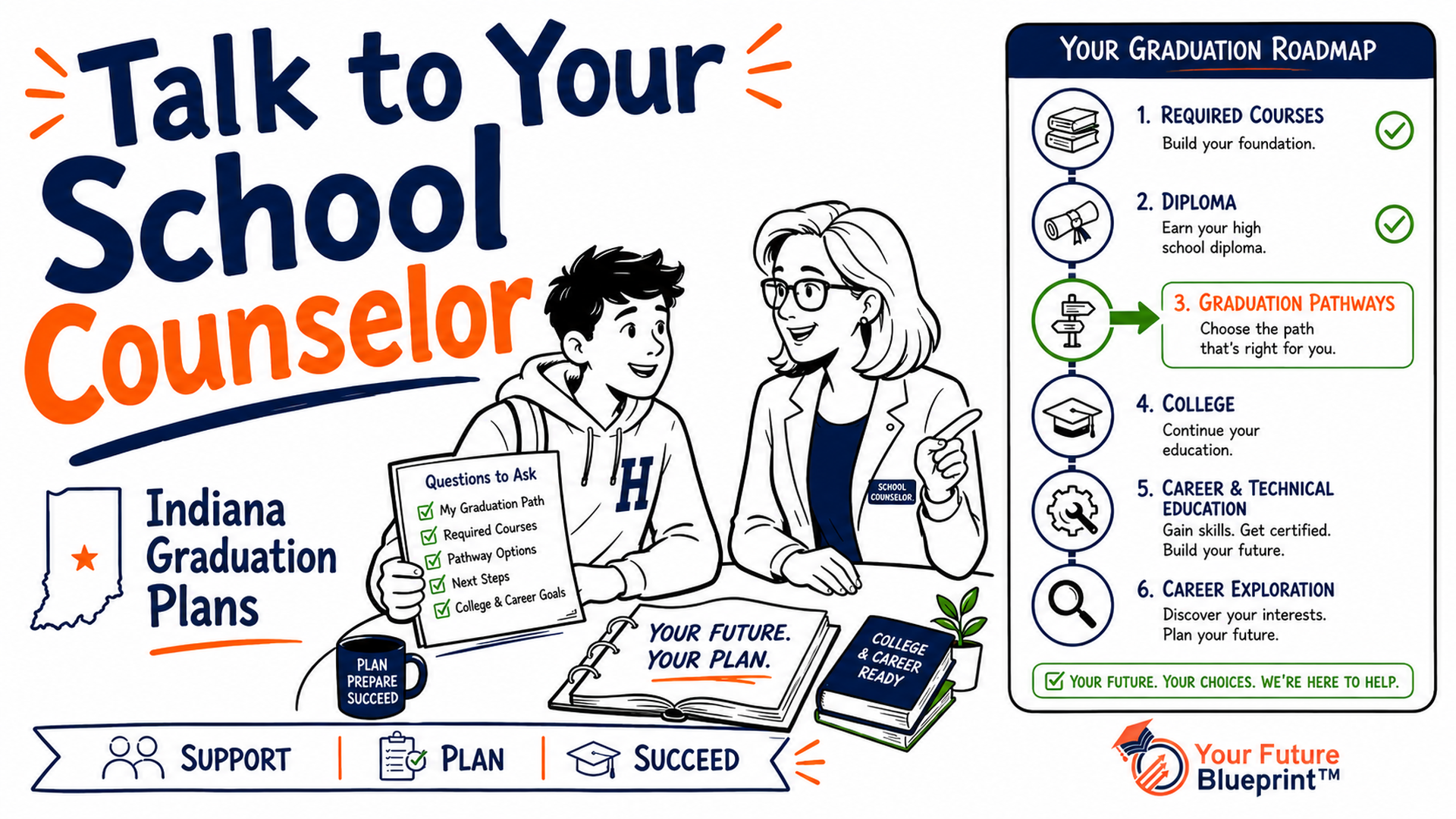
Indiana Graduation Pathways are designed to help students connect high school with what comes next. Instead of every student following the exact same route, students can complete requirements that align with their goals after graduation.
The Indiana Department of Education describes Graduation Pathways as a way for students to individualize graduation requirements around postsecondary goals such as enrollment, employment, or enlistment leading to service.
In plain language, Graduation Pathways help answer three questions:
- Did you complete the diploma course requirements?
- Did you show employability skills?
- Did you show that you are ready for a next step after high school?
The Three Main Parts
Students should think of Graduation Pathways as three connected pieces. Missing one piece can create problems later, even if a student is passing classes.
- Diploma requirements: The courses and credits needed for the diploma designation the student is pursuing.
- Employability skills: Real-world skills shown through approved experiences such as project-based, service-based, or work-based learning.
- Postsecondary-ready competency: A way to show the student is prepared for college, training, employment, military service, or another approved next step.
What Do Indiana Students Need to Graduate?
The first part is the academic foundation. Students must complete the course and credit requirements for the diploma designation they are earning.
Depending on the student’s situation, this may involve a designation such as Core 40, Academic Honors, Technical Honors, General, or another approved diploma option. Some current diploma paths have minimum credit requirements such as 40 credits for Core 40 or General designation and 47 credits for Academic Honors or Technical Honors.
Students should not rely only on a general number. They should confirm the exact requirement for their diploma path and graduation cohort.
The safest question to ask is simple: “Am I on track for the diploma designation I am trying to earn?”
How Do Students Meet the Employability Skills Requirement?
Indiana also wants students to show they are building skills that matter beyond the classroom. These are often called employability skills.
Students may demonstrate employability skills through experiences such as:
- Project-based learning
- Service-based learning
- Work-based learning
- Other approved local experiences or documentation
The point is not just to complete another task. The point is to show that students can apply academic, technical, and professional skills in a real setting.
What Counts as a Postsecondary-Ready Competency?
The third part asks students to show they are ready for a next step after high school. This is where students may have options.
Depending on current state rules and local school procedures, options may include things like:
- SAT, ACT, or ASVAB benchmarks
- Career and technical education pathways
- Industry-recognized credentials or certifications
- Advanced Placement, International Baccalaureate, Cambridge, dual credit, or CLEP options
- Federally recognized apprenticeships
- Locally created pathways approved through the proper process
Not every option fits every student. A student planning for a four-year college, a student entering a trade, and a student considering military service may choose different ways to show readiness.
How to Check Graduation Pathway Progress
Students should review their Graduation Pathway progress with their school counselor or designated school contact. Requirements can depend on the student’s graduation cohort and how the school or district implements the pathway.
Confirm which diploma requirements, employability skills evidence, and postsecondary-ready competency apply to the student, and use current Indiana Department of Education guidance as a reference.
What To Watch For
Graduation Pathways can feel confusing because there are multiple ways to complete some requirements. That flexibility is helpful, but it also means students should not guess.
- Do not assume credits are the whole story. Students may be earning credits but still need to document employability skills or a postsecondary-ready competency.
- Do not wait until senior year to ask questions. Some options require planning across multiple semesters.
- Do not assume every pathway is available at every school. Local course offerings, career programs, and documentation procedures can vary.
- Do not rely only on what a friend is doing. Two students can graduate through different pathways.
- Do not ignore diploma redesign updates. Indiana is changing diploma requirements for future cohorts, so students should confirm which rules apply to them.
What To Do If This Happens
If you are not sure whether you are on track to graduate, take action early.
- Ask your school counselor for your current Graduation Pathways status.
- Ask which diploma designation or diploma requirements apply to your graduating class.
- Ask whether your employability skills requirement has been completed and documented.
- Ask which postsecondary-ready competency option you are using.
- Ask what still needs to be finished before graduation.
- Keep a copy of your course plan, checklist, or progress report if your school provides one.
Questions To Ask Your Counselor
Your counselor is the best person to help you understand your school’s specific process. Bring direct questions so the meeting is useful.
- Which graduation requirements apply to my class?
- Which diploma designation am I currently working toward?
- Have I completed the employability skills requirement?
- Which postsecondary-ready competency option am I using?
- Do I need a test score, credential, dual credit, CTE sequence, apprenticeship, or another approved option?
- What should I complete this semester to stay on track?
- Is there a school-specific Graduation Pathways checklist I should use?
Official / Trusted Links
Continue Your Indiana Graduation Planning
For step-by-step guidance on Indiana graduation, college, career, and financial-aid planning, explore the Indiana Graduation, College & Career Planning Track.
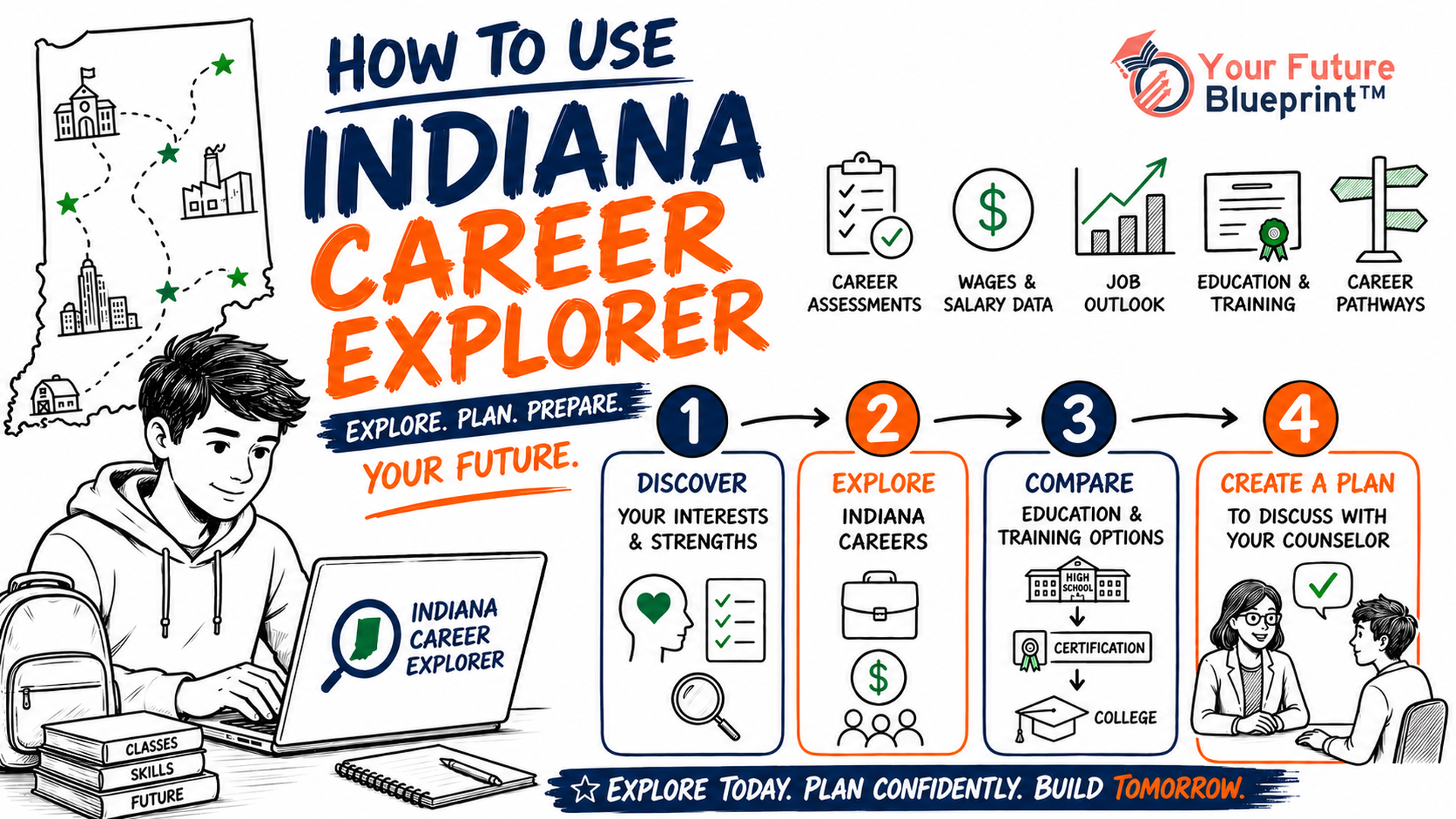
Students exploring careers can also learn how to use Indiana Career Explorer as a starting point for comparing occupations, education, and training options.
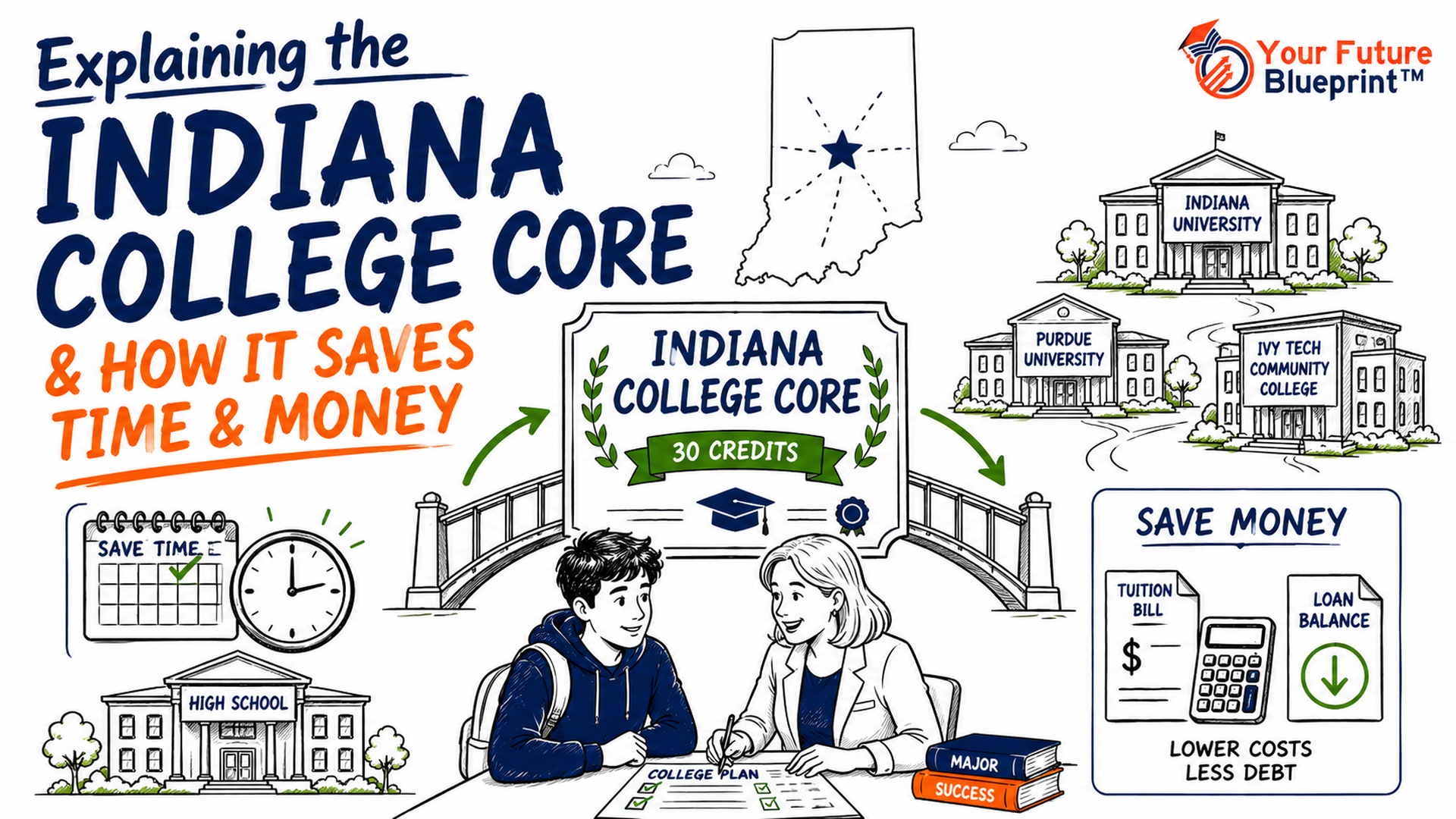
If college-level coursework may be part of your graduation plan, learn how the Indiana College Core can fit into high school and future college planning.
Juniors can use the Indiana Junior Year College & Career Planning Checklist, and seniors can follow the Indiana Senior Year College Application & Graduation Checklist.
Best Next Step
Ask your school counselor for your school’s Graduation Pathways checklist. Then compare that checklist with your current course plan, employability skills documentation, and postsecondary-ready competency option.
If you want extra help understanding Indiana-specific planning topics, you can also use the free State of Indiana Track.
Ready for the next step? Explore the recommended track for step-by-step guidance:
Counselor Share Note
This article is designed to be shared with students and families as a general educational overview. Families should still confirm graduation requirements with their high school counselor, school district, and official Indiana Department of Education resources.
Final Takeaway
Indiana Graduation Pathways are not meant to make graduation harder to understand. They are meant to help students connect high school with a real next step.
The key is to know your path early. Do not wait until the end of senior year to find out whether something is missing.
Ask for your checklist. Review your progress. Confirm your competency option. Then keep moving one step at a time.
Sources & References
Last Reviewed
May 2026
Disclaimer
This content is for general educational purposes only and does not constitute financial, legal, cybersecurity, identity theft recovery, tax, medical, mental health, academic advising, or professional advice. Students and families should consult with school counselors, financial aid offices, college representatives, school administrators, official agencies, healthcare professionals, or trusted advisors before making final decisions.
No personal student information is collected or stored when accessing free content through verified K–12 school platforms. Any optional tools that collect user-provided information should be reviewed with the platform’s Privacy Policy and Terms of Use.
View Transcript

Transcript note:
This transcript reflects the original video content. Some details may have changed since recording. Please use the reviewed article and official links above for current guidance.
You’re working hard in high school and earning credits. But in Indiana, graduation is not only about credits. Indiana has Graduation Pathways that students need to complete to earn a diploma.
These requirements are not just extra steps. They are designed to help show that you are ready for whatever comes next after high school. Understanding them now can help you stay on a smoother path to graduation.
The first part is your foundation: diploma requirements. That means earning the required credits in subjects like English, math, science, social studies, and other required areas. Many students work toward a diploma path that includes at least 40 credits, but students should confirm the exact requirements for their diploma and graduating class with their school counselor.
The second part is employability skills. Indiana wants students to show they are building skills for the real world. Students may demonstrate these skills through options such as project-based learning, service-based learning, work-based learning, or an approved capstone-style experience. Your school counselor can help you understand how your school tracks and documents this requirement.
The third part is postsecondary-ready competency. This is how you show that you are ready for a next step after high school. Options may include SAT, ACT, or ASVAB scores; a career and technical education pathway; an industry certification; AP, dual credit, or other approved coursework; or another approved option.
You do not have to figure this out alone. Your school counselor is your main guide for graduation requirements. They can help you choose the right courses, track your progress, and understand which competency option best fits your goals.
Understanding Indiana Graduation Pathways is about more than checking boxes. It is about choosing a route that prepares you for your future. No two paths look exactly alike, and that is part of the point.
You are in charge of your path, but you do not have to walk it by yourself. Your school counselors and teachers are there to guide you. If you want extra tools to stay organized, Your Future Blueprint can help you stay one smart step ahead.